
Blog
Valuing Carried Interest for Gift Tax: How Vesting, Waterfalls, and Transfer Restrictions Change Fair Market Value
Valuing carried interest for gift tax starts with the interest actually transferred, not a pro rata share of the fund or company. This guide shows how distribution waterfalls, vesting schedules, and transfer restrictions move fair market value on Form 709.
Published
Key Takeaways
Here is what founders, PE professionals, and their advisors need to know about valuing carried interest, restricted stock, and profits interests for gift tax:
- Standard of value: The IRS values a gift at fair market value on the date the gift is complete, measured as the price a willing buyer pays a willing seller. Equity Business Valuation Services applies that standard to the specific interest gifted, through gift tax business valuation reports prepared in accordance with USPAP.
- Waterfalls: A carried or profits interest is valued by modeling the distribution waterfall, including hurdles and preferred returns. A percentage of current capital does not measure its value.
- Vesting: Vesting conditions reduce value only to the extent forfeiture is real. A nominal forfeiture provision does not support a large discount.
- Restrictions and discounts: Transfer restrictions are disregarded under IRC 2703 unless the arrangement passes a 3-part test, and discounts for lack of control and marketability apply sequentially, not additively.
- Safe harbors: Rev. Proc. 93-27 and Rev. Proc. 2001-43 are income-tax safe harbors. Neither sets a gift-tax value of zero.
Gift tax valuation of a carried interest, restricted stock, or profits interest asks one question: what is this exact bundle of rights worth on the day it moves to a family member or trust? The answer depends on the waterfall, the vesting terms, the restrictions, and the special rules in IRC 2701 and 2703. This guide walks through each factor and shows how the math works.
What Standard Applies When You Gift a Carried or Profits Interest?
Fair market value on the gift date is the standard. Treas. Reg. 25.2512-1 defines fair market value as the price at which property changes hands between a willing buyer and a willing seller, neither under compulsion and both reasonably informed of the relevant facts. The Treasury Regulations under Part 25 also direct appraisers to consider a fair appraisal of business assets, demonstrated earning capacity, and the stock valuation factors in Treas. Reg. 25.2512-2 when valuing a business interest.
Revenue Ruling 59-60 supplies the working framework for closely held interests. Its factors include the nature of the business, the economic outlook, book value and financial condition, earning capacity, dividend-paying capacity, goodwill, prior sales, and the prices of comparable companies. Revenue Ruling 68-609 extends that framework to partnerships and other business interests.
The core principle is to value the interest gifted, not the entity. A 10% profits interest in an LLC does not equal 10% of the LLC's equity value, and an appraisal of it has to follow the rights written into the operating or partnership agreement. Our minority interest valuation guide covers the related discount mechanics for family business interests.
How Do Distribution Waterfalls and Hurdles Change Value?
A distribution waterfall determines who receives cash first, and that order drives the value of a carried or profits interest. Preferred returns, return hurdles, catch-up tiers, and carry percentages decide when the junior interest begins to participate. An appraiser values the interest by modeling these tiers across a range of outcomes, not by multiplying a percentage by current capital.
Example: An LLC is worth $50,000,000 on the gift date. A profits interest has a $50,000,000 distribution threshold and a 10% participation above it. The liquidation value of that interest today is $0, because a sale at the current value pays the holder nothing. The interest still carries value, since a buyer would pay for the right to share in appreciation above $50,000,000. A scenario analysis or option-style model captures that upside, and the result is neither $0 nor $5,000,000 (10% of equity).
An appraiser reviewing a carried interest also considers the following inputs:
- Timing and probability of investment realizations
- Preferred-return and catch-up tiers
- Management fees and fund expenses that reduce distributable profit
- Clawback exposure on earlier distributions
- Key-person and performance conditions in the governing agreement
How Do Vesting Schedules Affect the Gift Value?
Vesting reduces fair market value when a hypothetical buyer faces a real risk of losing the interest. Several factors set the size of that reduction:
- Probability of vesting: A recipient who is very likely to remain in the role warrants a small reduction.
- Length of the vesting period: Longer periods carry more forfeiture risk than short ones.
- Service versus performance conditions: Performance conditions tied to exits or return targets add uncertainty that service-only conditions lack.
- Distributions before vesting: An interest that receives distributions during the vesting period carries less risk than one that does not.
- Death, disability, and change-of-control terms: Acceleration provisions on these events reduce forfeiture risk and shrink the discount.
Nominal forfeiture provisions do not support large discounts. A provision that is never enforced, or that the donor controls, carries little economic risk, and an appraiser tests it against how the agreement operates in practice.
The donor's retained powers also raise a completed-gift issue. A gift is incomplete when the donor keeps dominion and control, for example the power to cancel, accelerate, or modify vesting. A transfer of a nonvested interest also needs a separate review of whether it is a present interest for annual exclusion purposes. Estate attorneys resolve both questions before the appraisal date is fixed.
Which Transfer Restrictions Reduce Value?
Transfer restrictions reduce value only when they pass IRC 2703. Under that section, a right or restriction on the sale or use of property is disregarded unless 3 conditions hold:
- The arrangement is a bona fide business arrangement.
- The arrangement is not a device to transfer property to family members for less than full consideration.
- The terms are comparable to similar arrangements entered into at arm's length.
Buy-sell provisions, consent-to-transfer clauses, and rights of first refusal all face this test. Restrictions that lapse or that only bind family members also face IRC 2704, and the regulations disregard certain applicable restrictions when the transferor and family control the entity. Our buy-sell agreement valuation guide explains when a formula price holds.
Restricted stock adds a securities-law layer. Rule 144 holding periods and contractual lockups affect marketability, and the appraiser measures them against the facts on the gift date.
How Waterfalls, Vesting, and Restrictions Compare
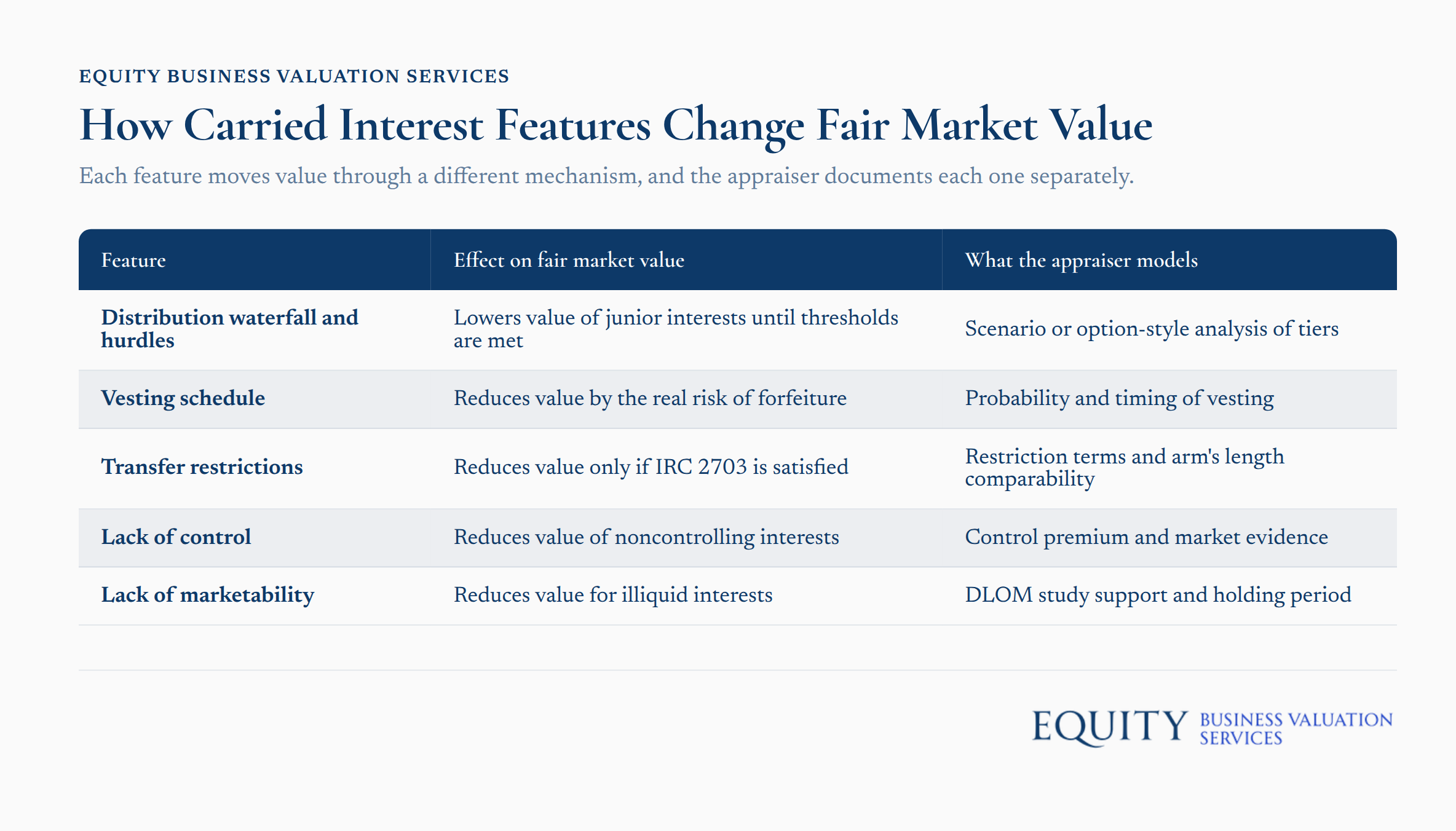
Each feature of the interest moves value through a different mechanism, and the appraiser documents each one separately. The table below summarizes the effect and the analysis behind it.
| Feature | Effect on fair market value | What the appraiser models |
|---|---|---|
| Distribution waterfall and hurdles | Lowers value of junior interests until thresholds are met | Scenario or option-style analysis of tiers |
| Vesting schedule | Reduces value by the real risk of forfeiture | Probability and timing of vesting |
| Transfer restrictions | Reduces value only if IRC 2703 is satisfied | Restriction terms and arm's length comparability |
| Lack of control | Reduces value of noncontrolling interests | Control premium and market evidence |
| Lack of marketability | Reduces value for illiquid interests | DLOM study support and holding period |
How Do Control and Marketability Discounts Combine?
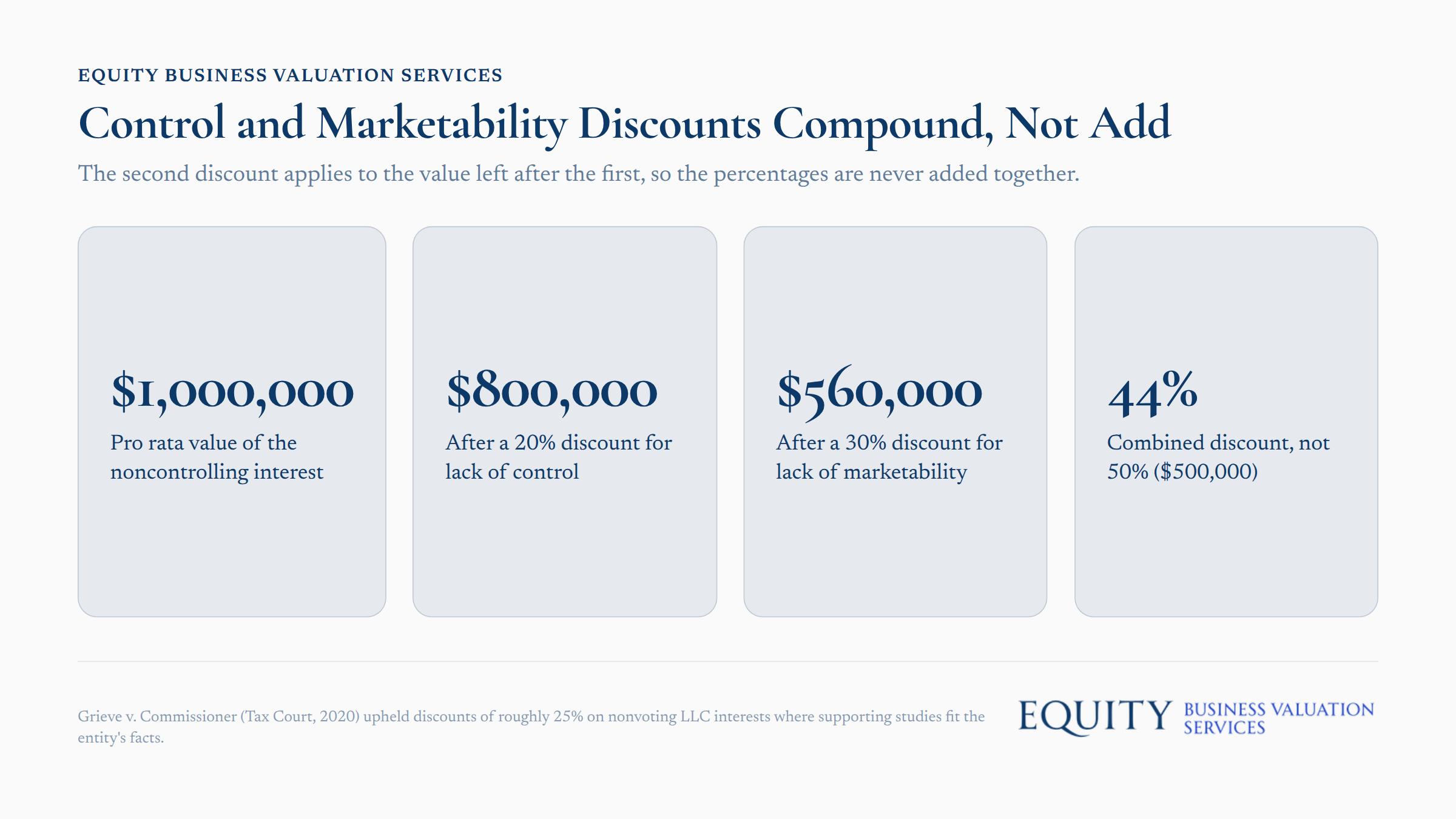
Discounts for lack of control and lack of marketability apply sequentially. The second discount applies to the value left after the first, so the percentages are never added together.
Example: A noncontrolling interest has a pro rata value of $1,000,000. A 20% discount for lack of control leaves $800,000. A 30% discount for lack of marketability then reduces $800,000 to $560,000. The combined discount is 44%, not 50%, which would have produced $500,000.
The IRS Valuation Advisor job aid on discounts for lack of marketability cautions against mechanically applying average restricted-stock study discounts. In Grieve v. Commissioner (Tax Court, 2020), the court upheld discounts of roughly 25% on nonvoting LLC interests because supporting studies fit the facts of that entity. Support specific to the interest, not a rule of thumb, carries a discount. Our guide to discounts for lack of marketability covers the study methods in more detail.
When Does IRC 2701 Change the Gift Value?
IRC 2701 applies when a transferor keeps an applicable retained interest with extraordinary payment rights in a corporation or partnership and transfers a junior interest to a family member. The regulations under 25.2701-1 apply a subtraction method, which values the gift by removing the retained interest's value from the total value of the family-held interests. Under the zero-value rule in IRC 2701, a retained interest without a qualified payment right is valued at zero, which raises the value of the gift.
Not every retained carried interest is worth zero. The result depends on the rights the donor keeps, such as preferred distributions, liquidation, put, call, or conversion rights. Appraisers and counsel review the entity's agreement line by line before applying the rule.
Why Rev. Proc. 93-27 and Rev. Proc. 2001-43 Do Not Set Gift Value
Rev. Proc. 93-27 and Rev. Proc. 2001-43 are income-tax safe harbors for profits interests received for services. Each addresses whether the recipient owes income tax at grant. Neither establishes that a profits interest has zero fair market value, and neither overrides IRC 2701 or the gift-tax valuation rules.
The IRC 83(b) election follows the same split. A 30-day election governs income tax on restricted property received for services. The election has no effect on the gift-tax value a donor reports on Form 709.
Annual Exclusion, Basic Exclusion Amount, and Form 709
The 2026 annual gift exclusion is $19,000 per donee, the same as 2025. The basic exclusion amount is $15,000,000 for 2026 under Public Law 119-21, up from $13,990,000 in 2025.
A gift that exceeds the annual exclusion, or that is not a present interest, is reported on Form 709, as the IRS gift tax FAQ explains. The appraisal and supporting documents go with the return. Our guide to reporting business equity gifts on Form 709 covers the filing mechanics.
What Does a Carried Interest Gift Tax Appraisal Cost?
Equity Business Valuation Services quotes a fixed fee before work begins and never bills hourly. Our published pricing for business valuation starts at $4,500 for a standard report and $5,500 for an advanced, IRS-qualified report. Scope drives the final fee: the complexity of the waterfall, the quality and completeness of fund and entity records, the number of entities and interests, the intended use, and the depth of analysis required.
Business valuation is performed remotely. Our appraisers hold credentials with leading organizations such as the ASA and NACVA, and each report is prepared in accordance with USPAP, the standards published by The Appraisal Foundation.
Document the Value Before the Assignment Is Signed
A defensible gift tax valuation of a carried interest, restricted stock, or profits interest starts with the governing agreement, the waterfall, the vesting terms, and the entity's financials as of the gift date. Founders, PE professionals, and executives who gather those documents before signing the assignment give their CPA and estate attorney a report built on the actual rights transferred. To begin, request an appraisal from Equity Business Valuation Services and receive a fixed-fee quote after scoping.
This article is provided for general informational purposes only and does not constitute legal, tax, or financial advice. Readers should consult a qualified attorney or CPA regarding their specific circumstances.