
Blog
Buy-Sell Agreement Gift Tax Valuation: When the Formula Price Holds and When the IRS Ignores It
Buy-sell agreement gift tax valuation turns on IRC Section 2703: a formula price controls only if the agreement passes 3 tests. This guide shows what makes an agreement bona fide, when the IRS disregards it, and how Connelly changed the estate tax picture.
A buy-sell agreement does not automatically set the value of a business interest you give away. For gift and estate tax purposes, the agreement's price is respected only if it survives the three-part test in IRC Section 2703. If it fails, the IRS values the interest as if the restriction did not exist, and a gift reported at a low formula price can be recast at a much higher fair market value.
This guide explains how buy-sell agreements interact with gift tax valuation, what "bona fide" actually means, and what recent law means for owners planning a transfer. It is written for owners and advisors preparing a Form 709 for a closely held interest, the kind of engagement our gift tax business valuation service is built for.
Key takeaway: A formula price in a buy-sell agreement is evidence of value, not proof of value. It controls only when the agreement meets all 3 requirements of Section 2703(b).
How Does a Buy-Sell Agreement Affect the Value of a Gifted Business Interest?
A buy-sell agreement affects gift tax value only when it satisfies Section 2703(b). When it does, its restrictions and price terms can be considered as part of the interest's legal and economic attributes. When it does not, the agreement is ignored and the interest is valued under the standard willing-buyer, willing-seller test.
That standard, fair market value, is the price at which property changes hands between a willing buyer and a willing seller, neither under compulsion and both with reasonable knowledge of the facts. For a gift, the measurement date is generally the date the gift is complete.
The interest itself can still reflect real economic limits, such as lack of control or lack of marketability. Those are legitimate valuation considerations, and we cover how they work in our guide to valuation discounts for FLP and LLC interests. What a contract cannot do is push the value below fair market value when Section 2703 says the contract must be disregarded.
What Does IRC Section 2703 Actually Say?
Section 2703(a) tells the valuer to ignore two things when valuing transferred property:
- Purchase rights: Any option, agreement, or other right to acquire or use the property at a price below its fair market value, determined without regard to that right.
- Sale restrictions: Any restriction on the right to sell or use the property.
Section 2703(b) then carves out an exception. The agreement counts only if all three of these tests are met:
- Bona fide business arrangement. The agreement serves a genuine business purpose.
- Not a device. It is not a device to transfer property to family members for less than full and adequate consideration in money or money's worth.
- Arm's-length comparability. Its terms are comparable to similar arrangements entered into at arm's length.
Miss one and the whole agreement drops out of the valuation. The Treasury regulations under the gift tax rules in Part 25, including Treas. Reg. 25.2703-1, elaborate on how these tests are applied.
What Makes a Buy-Sell Agreement "Bona Fide"?
A bona fide agreement exists for a real business reason, such as continuity of ownership, management control, or an orderly succession, and it operates the way the document says it does. Courts and the IRS look at substance, not the title on the first page.
In our experience reviewing these agreements, the practical indicators fall into a recurring pattern:
- Binding during life and at death: The restriction applies to lifetime transfers and to transfers at death, not only when it is convenient.
- Price fixed or determinable: The agreement states a price or a formula that can be computed without discretion by the family.
- Not a testamentary substitute: It is not simply a way to pass wealth to the next generation at a discount.
- Adopted for a business purpose: The record shows why the owners entered into it, ideally well before any gift or death was in view.
- Followed in practice: Prior buyouts, if any, were priced and closed under the agreement's own terms.
- Updated over time: The formula is revisited as the company and market change, rather than frozen at a stale number.
The Tax Adviser's discussion of buy-sell agreements and business interest value makes a related point: a method should establish fair market value as of the transaction date and account for applicable discounts, and the IRS may redetermine value where the agreement operates as a device to move property to family for less than full consideration.
The Family Ownership Safe Harbor
The regulation provides a safe harbor. If more than 50% by value of the property subject to the restriction is owned directly or indirectly by people who are not members of the transferor's family, the agreement is treated as meeting the tests. The logic is simple: unrelated owners have no reason to agree to terms that quietly favor your family.
Be careful with this rule. The statutory presumption speaks most directly to the device and comparability tests, so the business purpose behind the agreement still needs to be documented.
Watch out: An agreement among siblings or a parent and children, with no unrelated owners, gets no help from the safe harbor. It has to pass all 3 tests on its facts.
When Is the Formula Price Respected and When Is It Disregarded?
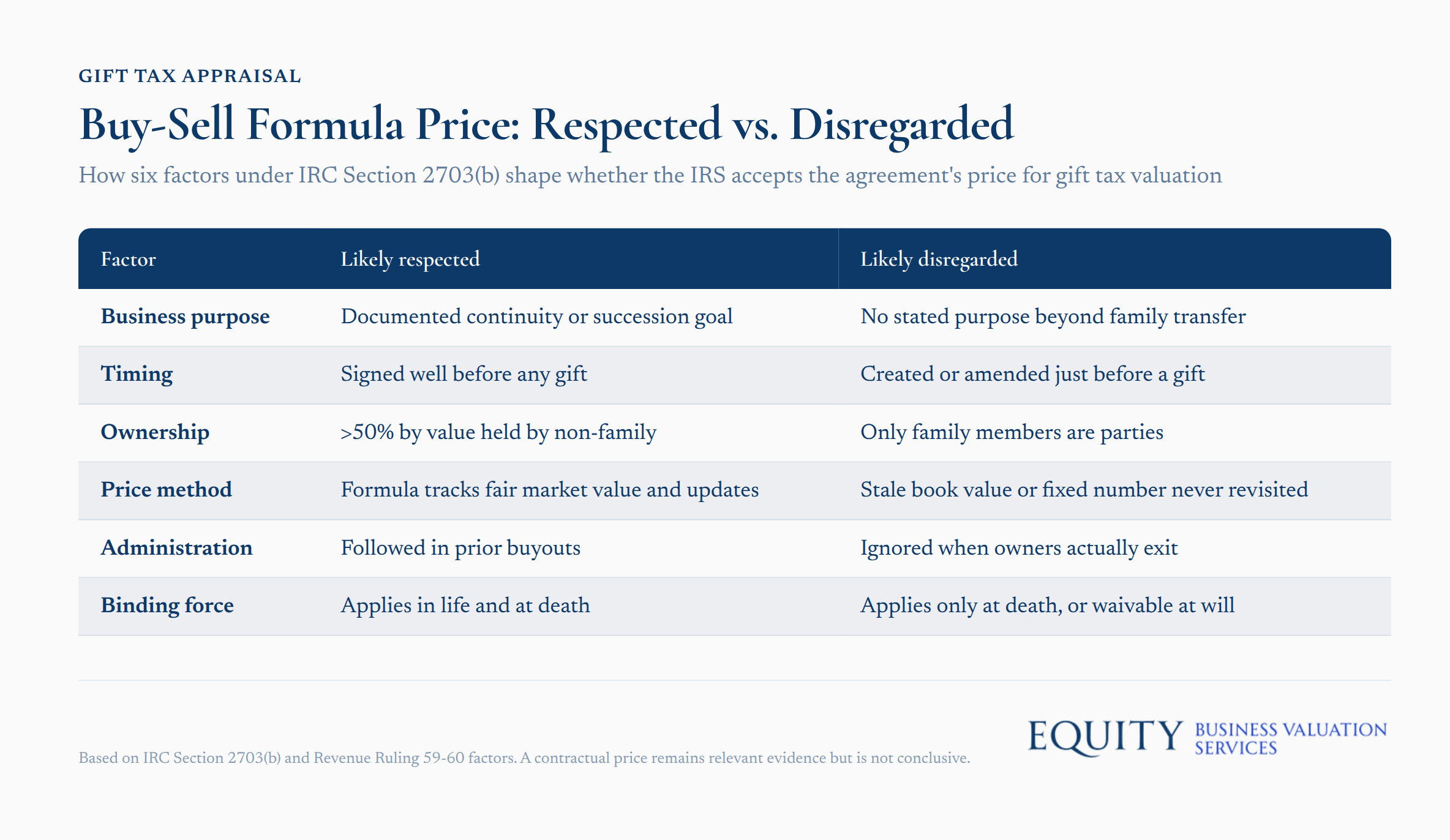
The formula price is respected when the agreement clears all 3 tests and the price is commercially credible. It is disregarded when any test fails, or when the formula bears no relationship to what a real buyer would pay. The table below compares how the two outcomes typically look.
| Factor | Likely respected | Likely disregarded |
|---|---|---|
| Business purpose | Documented continuity or succession goal | No stated purpose beyond family transfer |
| Timing | Signed well before any gift | Created or amended just before a gift |
| Ownership | More than 50% by value held by non-family | Only family members are parties |
| Price method | Formula tracks fair market value and updates | Stale book value or fixed number never revisited |
| Administration | Followed in prior buyouts | Ignored when owners actually exit |
| Binding force | Applies in life and at death | Applies only at death, or waivable at will |
Example: A family company is worth $5,000,000 on the gift date. A parent gives a 30% interest to a child, and the buy-sell agreement prices shares at book value, which implies $600,000 for that block. If the agreement fails Section 2703(b), the IRS ignores that formula, and our valuation may conclude a materially higher figure for the 30% interest after considering control, marketability, and the other Revenue Ruling 59-60 factors. The gift is then measured against the higher number, not $600,000.
A contractual price can still be relevant evidence even when the agreement is disregarded. It just is not conclusive. Our appraisers weigh it alongside financial statements, prior transactions, capitalization rates, and the size and rights of the interest. For the specific cases that have tested these questions, such as Estate of Lauder, Estate of Blount, and Estate of True, we describe only the general principle here.
How Did Connelly v. United States Change Buy-Sell Planning?
In Connelly v. United States (2024), the Supreme Court held that a corporation's obligation to redeem shares does not offset the life insurance proceeds it receives when valuing the company for estate tax. Insurance-funded redemption agreements can therefore increase the value of the company, and with it the decedent's shares.
Connelly is an estate tax decision, but it matters for gift planning in two ways. First, it shows that a buy-sell agreement's mechanics can raise value instead of lowering it. Second, owners who use gifts to move equity to the next generation should confirm how any entity-owned insurance or redemption obligation is treated in the valuation.
Valuation commentary increasingly frames the issue as whether an agreement truly fixes a price or merely fixes risk, a distinction explored in Mercer Capital's March 2026 valuation newsletter. An agreement written years ago around a different structure may no longer do what the owners think.
Pro tip: If your agreement is funded by company-owned life insurance, review it before making any gift of stock. Entity-owned policies can affect the value of the interest you are transferring.
How Does This Fit With Form 709 and the Gift Tax Rules?
A gift of a business interest is reported on Form 709, which is due April 15 of the year after the gift. You can read more about timing in our guide on the Form 709 deadline. The annual exclusion for 2025 and 2026 is $19,000 per recipient, and according to legal commentary the 2026 federal estate and gift lifetime exemption is $15,000,000 per individual, adjusted for inflation.
Because most gifts of business interests exceed the annual exclusion, they are reported and counted against the lifetime exemption. That makes the reported value important: it is the number that reduces your remaining exemption.
The gift tax regulations also matter when an interest is sold under a buy-sell agreement. Treas. Reg. 25.2512-8 provides that a gift can arise when the value transferred exceeds the consideration received, while an ordinary-course business transaction that is bona fide, at arm's length, and free of donative intent is treated as made for adequate and full consideration. A low formula price alone does not prove that no gift occurred.
How We Value an Interest Subject to a Buy-Sell Agreement
We start with the agreement itself and test it against Section 2703(b) before we rely on any number in it. Our appraisers, who hold credentials with leading organizations such as the ASA and NACVA, prepare each report in accordance with USPAP and IRS requirements for Form 709.
Our review generally covers these steps:
- Agreement analysis: Parties, purpose, date, binding terms, and how the price is set.
- Administration history: Whether prior buyouts followed the formula.
- Ownership mix: Family versus non-family holdings, for the safe harbor analysis.
- Independent valuation: Fair market value of the interest under the Revenue Ruling 59-60 framework, including control and marketability considerations.
- Reconciliation: How the formula price compares with the independent conclusion.
Fees are driven by scope: the complexity of the entity, the quality of its records, the number of entities or interests involved, and whether you need a standard report or an IRS-qualified one. Our business valuation fees start at $4,500 for a standard report and $5,500 for an advanced, IRS-qualified report. Every engagement is quoted as a fixed fee before work begins and is never billed hourly.
Review Your Agreement Before You Gift
Check the agreement before the gift, not after the return is filed. If it was signed long ago, never followed, or priced off a stale formula, assume the IRS may ignore it and plan around an independent valuation instead.
If you are preparing to transfer an interest in a closely held company, you can request an appraisal and we will scope the engagement and quote a fixed fee.
This article is provided for general informational purposes only and does not constitute legal, tax, or financial advice. Readers should consult a qualified attorney or CPA regarding their specific circumstances.