
Blog
Why a USPAP-Compliant Gift Tax Appraisal Protects Your Form 709 Filing
A USPAP-compliant gift tax appraisal is what stands between a smooth Form 709 filing and an IRS valuation dispute over a closely-held business gift. Here's what the standard requires, why gaps invite scrutiny, and how to check a report before you file.
Gifting an interest in a closely-held business or family LLC triggers a federal reporting obligation that lives or dies on one number: the fair market value you report on Form 709. For donors in Massachusetts and DC, where attorneys and CPAs routinely handle sophisticated family wealth transfers, the appraisal behind that number needs to do more than look professional. It needs to meet the development and reporting standards that the IRS and the Tax Court actually test when a valuation gets challenged. This article covers what USPAP compliance requires of a gift tax appraiser, why thin reports draw scrutiny, and a practical checklist to run before you file.
What USPAP Compliance Requires of a Gift Tax Appraiser
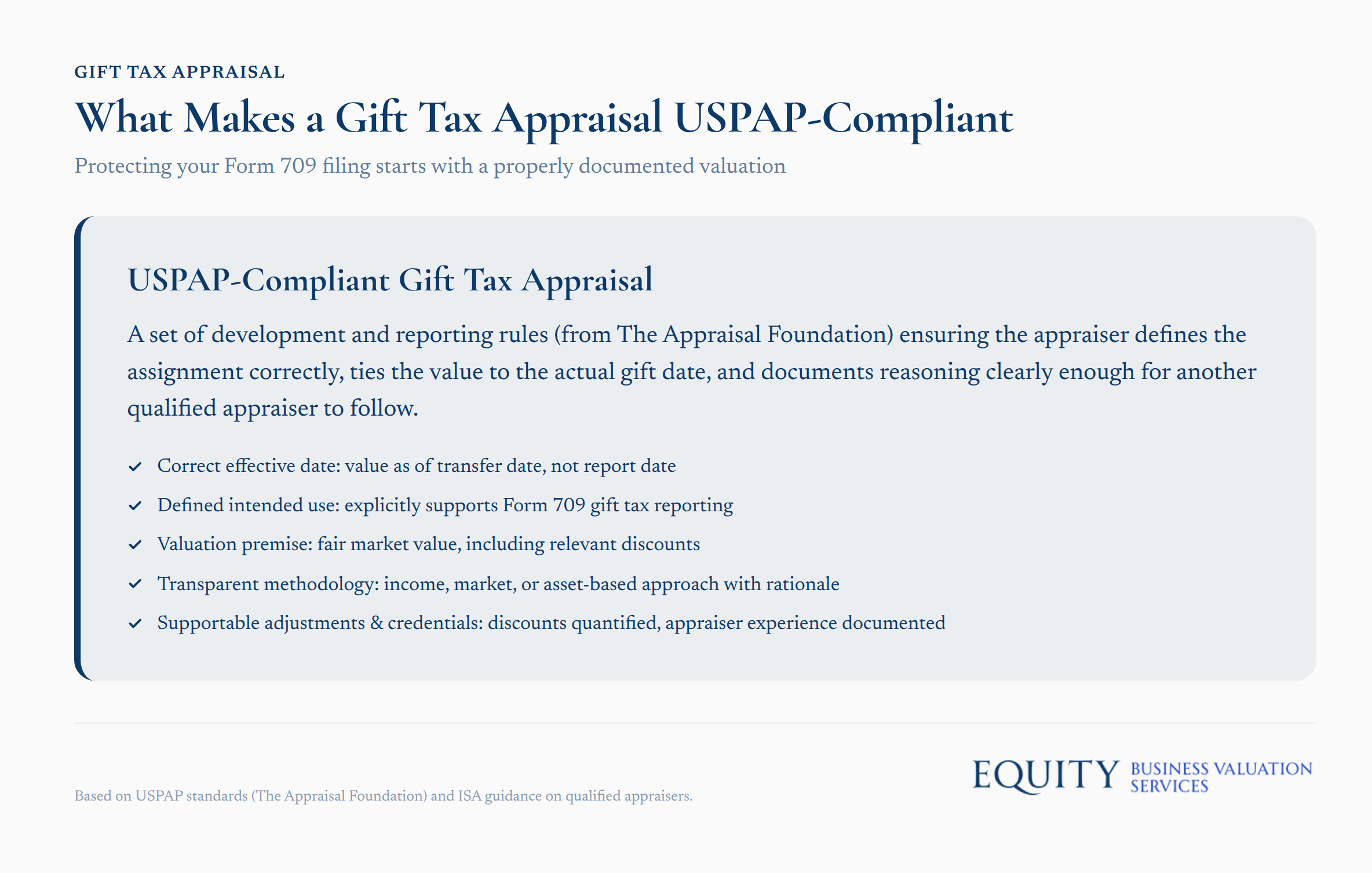
USPAP (the Uniform Standards of Professional Appraisal Practice, published by The Appraisal Foundation) is a set of development and reporting rules, not a tax statute. For a gift of a business interest, FLP unit, or LLC membership share, compliance means the appraiser has defined the assignment correctly, tied the conclusion to the actual date of the gift, and documented the reasoning well enough that another qualified appraiser could follow it.
In practice, a USPAP-compliant report for a business valuation gift addresses these elements:
- Correct effective date: the value is as of the transfer date, not the date the report was written or signed.
- Defined intended use: the report states plainly that it supports federal gift tax reporting on Form 709, which shapes what disclosures are required.
- Valuation premise and standard of value: fair market value is defined and applied, including any control, marketability, or minority discounts relevant to the interest transferred.
- Transparent methodology: the appraiser identifies whether the conclusion rests on an income, market, or asset-based approach, and explains why.
- Supportable adjustments: discounts for lack of control or lack of marketability are quantified and explained rather than simply asserted.
- Appraiser qualifications: the report identifies the appraiser's credentials and relevant experience valuing the specific type of interest.
A qualified appraiser, as the International Society of Appraisers explains, is someone who holds recognized credentials, has verifiable experience with the asset class, and regularly performs appraisals for compensation. Business valuation credentials commonly referenced include the ASA and NACVA, alongside general adherence to USPAP and The Appraisal Foundation's standards. No single appraiser carries every credential; what matters is that the individual on your engagement has demonstrable experience with closely-held interests specifically.
Why Non-Compliant Reports Draw IRS and Tax Court Scrutiny
A gift tax appraisal that skips the substance of USPAP, even if it's well-formatted, is exactly the kind of report that invites an IRS valuation challenge. The issue isn't aesthetics. It's whether the report supplies the information the IRS needs to evaluate the number on its own terms.
Two legal mechanisms explain why this matters so much for Form 709 filings specifically.
The Adequate Disclosure Rule
Under Treasury Regulation 301.6501(c)-1(f)(2), a gift is treated as "adequately disclosed" on a gift tax return only if the filing includes a description of the transferred property, the identity of the parties, and a detailed statement of the valuation method used, including any discounts claimed and the factual basis for them. If a return meets this adequate disclosure standard, the IRS generally has only three years to challenge the reported value; if it doesn't, the statute of limitations never starts running on that gift, leaving the valuation open to challenge indefinitely. As estate planning commentary on this rule explains, adequate disclosure functions as the gateway to a running statute of limitations, and a thin or boilerplate appraisal is the most common reason a return fails to clear that bar.
A separate but related body of IRS guidance has historically set out the specific information a federal transfer tax appraisal report should include: a description of the property, the appraiser's qualifications, the valuation date, the basis for the valuation, and the methodology applied. That guidance predates modern USPAP but its substance is now incorporated into the reporting standards most appraisal organizations require their members to follow. The practical effect is the same whether you call it adequate disclosure or appraisal guidelines: a report that is silent on methodology, discount support, or the appraiser's basis for the conclusion does not satisfy either standard.
What the IRS and Courts Actually Look For
Industry commentary on recent valuation disputes makes a consistent point: the IRS and Tax Court scrutinize whether a report genuinely qualifies as a "qualified appraisal" and whether the return meets adequate disclosure, not just whether a CPA or appraiser signed something that looks official. Common failure points include unsupported discount percentages, missing explanation of why a particular valuation approach was chosen, and a mismatch between the stated valuation date and the actual date of transfer.
IRS Chief Counsel guidance on business valuation matters reinforces that examiners expect to see the underlying financial analysis, not just a summary conclusion, when a closely-held interest is at issue. (See IRS Chief Counsel Advice 202152018 for an example of how the agency approaches valuation documentation in a business context.) A report built to USPAP's development and reporting standards is far more likely to contain that underlying analysis as a matter of course, because the standard requires it regardless of the intended use.
Watch out: A report that states a discount percentage without walking through comparable restricted-stock studies, partnership-level data, or entity-specific factors is one of the fastest ways to lose an IRS examination. The number needs a documented basis, not just a citation to "industry standard" ranges.
A Practical Checklist Before You File Form 709
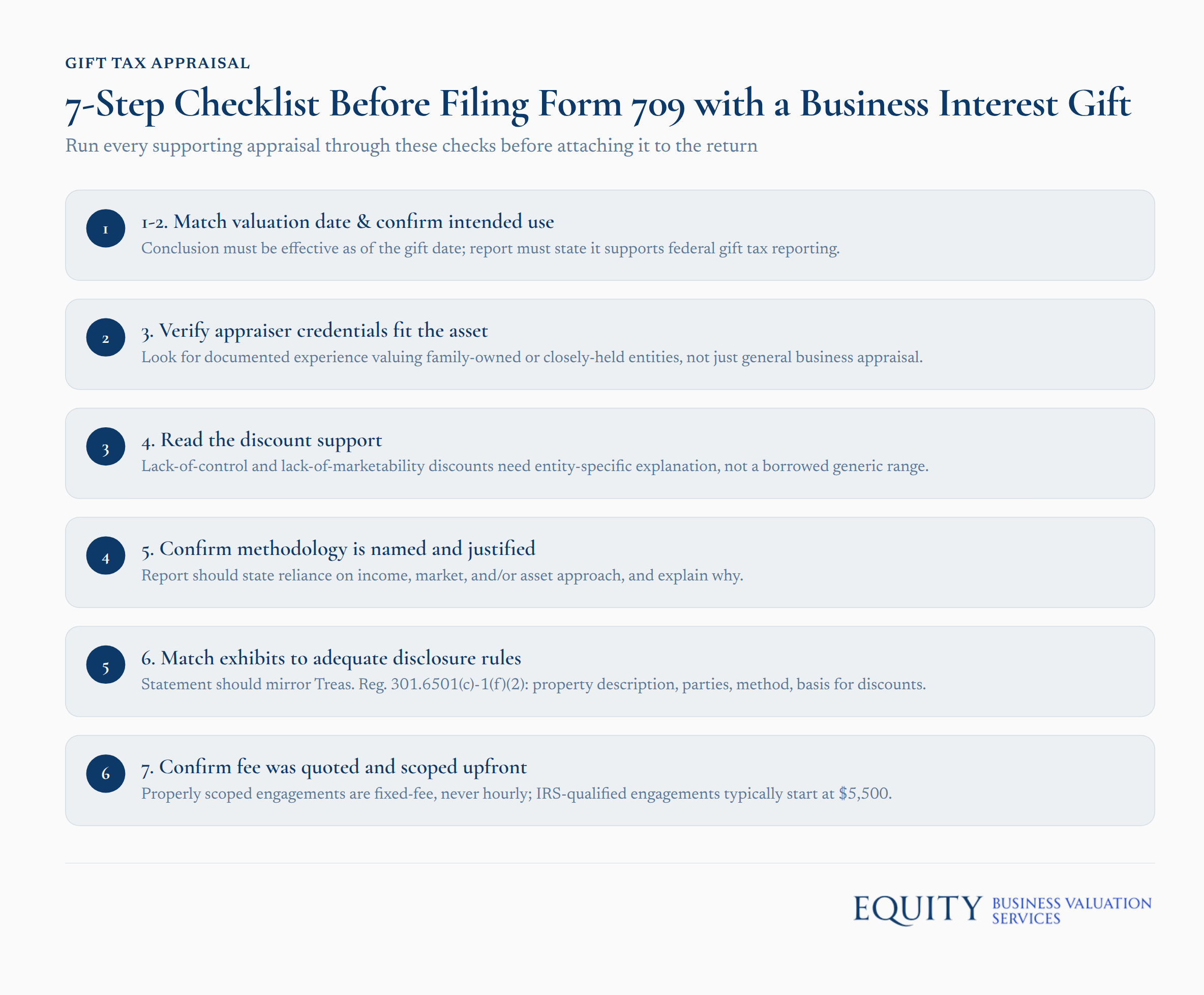
Before a Form 709 goes out the door with a business interest, FLP unit, or LLC gift attached, run the supporting appraisal through this checklist.
- Confirm the valuation date matches the gift date. The report's conclusion should be effective as of the actual transfer, not a nearby fiscal year-end or the report's publication date.
- Check that the intended use is stated. The report should say explicitly that it is prepared to support federal gift tax reporting, since that framing drives what disclosures the return needs.
- Verify the appraiser's credentials and experience match the asset. A generalist business appraiser without closely-held entity experience is a weaker fit than one with a documented history valuing family-owned interests.
- Read the discount support, not just the discount number. Lack-of-control and lack-of-marketability discounts need their own explanation tied to the specific entity, not a generic range borrowed from another engagement.
- Make sure the methodology is named and justified. The report should say whether it relies on an income approach, a market approach, an asset approach, or some combination, and why.
- Match the report's exhibits to the adequate disclosure checklist. The return's attached statement should mirror what Treas. Reg. 301.6501(c)-1(f)(2) requires: property description, parties involved, valuation method, and the factual basis for any discounts.
- Confirm the fee was quoted and scoped before work began. A properly scoped engagement is quoted as a fixed fee once the appraiser understands the entity structure and the number of interests involved; it is never billed hourly. Our IRS-qualified business valuation engagements are typically quoted from $5,500, with scope (not the concluded value) driving the final fee.
For donors and advisors who want a deeper look at how fair market value is distinguished from a casual appraised figure, our guide on qualified appraisals and fair market value for gift tax walks through that distinction in more detail. And for family businesses specifically, our piece on valuing a minority interest for gift tax purposes covers how discounts for lack of control get documented in practice.
Massachusetts and DC: Why the Audience Still Needs a Federal-Grade Report
Gift tax is a federal matter; there is no separate Massachusetts or DC gift tax on the lifetime transfer itself, and Massachusetts estate tax guidance confirms the state's tax system operates at the estate level rather than through a standalone gift tax. DC's local tax system works the same way: it taxes estates, not lifetime gifts, under local law.
That doesn't make the appraisal less important for donors in these jurisdictions. A lifetime gift of a business interest still needs to be reported on the federal Form 709, and the value of that gift can resurface years later when the donor's estate is settled, whether in Massachusetts, DC, or elsewhere. A gift tax appraisal with weak documentation today becomes a liability when an estate's adjusted taxable gifts need to be reconstructed for a Massachusetts or DC estate tax filing down the road. Building the report to USPAP's standard the first time removes that future risk.
Getting the Valuation Right the First Time
A USPAP-compliant gift tax appraisal is the difference between a Form 709 that starts the clock on the IRS's audit window and one that stays open to challenge indefinitely. For gifts of closely-held business interests, FLP units, and LLC membership shares, the standard isn't a formality: it's what makes the reported discounts, methodology, and valuation date defensible if the IRS ever asks. Donors, attorneys, and CPAs who check a report against the standard before filing protect the client from exactly the kind of dispute that adequate disclosure rules were written to prevent.
If you're preparing a gift of a business interest and need a report built to withstand IRS review, our business valuation team scopes and quotes gift tax engagements as a fixed fee before any work begins.
This article is provided for general informational purposes only and does not constitute legal, tax, or financial advice. Readers should consult a qualified attorney or CPA regarding their specific circumstances.