
Blog
Fair Market Value vs. Appraised Value: Why a Qualified Appraisal for Gift Tax Matters
A dealer letter or online price estimate is not the same as a qualified appraisal for gift tax reporting, and the gap between them can cost a donor penalties and an open-ended IRS audit window. This guide walks through what the appraisal must document to start the statute of limitations and avoid valuation penalties.
When someone gifts closely held business stock, an interest in a family LLC, or a valuable piece of art, the number that ends up on Form 709 has to be defensible. Fair market value is the legal standard the IRS applies to that gift. An appraised value is only as good as the appraisal that produced it, and not every valuation opinion meets the bar the IRS actually enforces. Understanding the difference, and knowing what a qualified appraisal for gift tax purposes must contain, is the difference between a clean filing and years of open audit exposure.
Fair Market Value Is the Standard, Not Whatever Number Someone Wrote Down
Fair market value is the price at which property would change hands between a willing buyer and a willing seller, neither one under compulsion to act and both reasonably informed about the relevant facts. That definition sounds simple. Applying it to a 22% interest in a family LLC or a closely held manufacturing business is not.
The IRS does not require that every gift come with a formal appraisal report. But for anything beyond routine cash gifts, an informal opinion of value, a broker's letter, a dealer's offer, or a number pulled from an online estimator, will not hold up if the IRS ever questions the return. That is where the concept of a qualified appraisal becomes central to gift tax planning, not just charitable deduction planning.
Key takeaway: the IRS accepts a reported gift value as final only when the return contains enough documented, methodology-backed support to start the audit clock. A number without that support stays open to challenge indefinitely.
What Rev. Proc. 66-49 Started and How Later Rules Built on It
The expectation that a gift or donation appraisal report include specific content is not new. IRS Revenue Procedure 66-49 laid out the original framework: a description of the property, the appraiser's qualifications, the valuation method used, the effective date of the valuation, and the appraiser's signed statement of the value reached. Those elements are still recognizable in every appraisal standard used for tax purposes today.
Congress and Treasury layered more specific rules on top of that foundation. IRC §170(f)(11) and Treasury Regulation §1.170A-17 now define exactly what makes an appraiser "qualified" and what makes an appraisal "qualified," originally for charitable contribution purposes. Professional appraisal organizations point back to that same regulatory chain when explaining what the IRS expects in a report supporting a gift or donation of property, including the appraiser's credentials, a statement that the report was prepared for the intended tax purpose, and the appraised value as of the relevant date, per guidance published by the American Society of Appraisers.
For gift tax specifically, a separate regulation carries the same expectations forward: Treasury Regulation §301.6501(c)-1(f) sets the "adequate disclosure" rule for Form 709.
The Adequate Disclosure Safe Harbor on Form 709
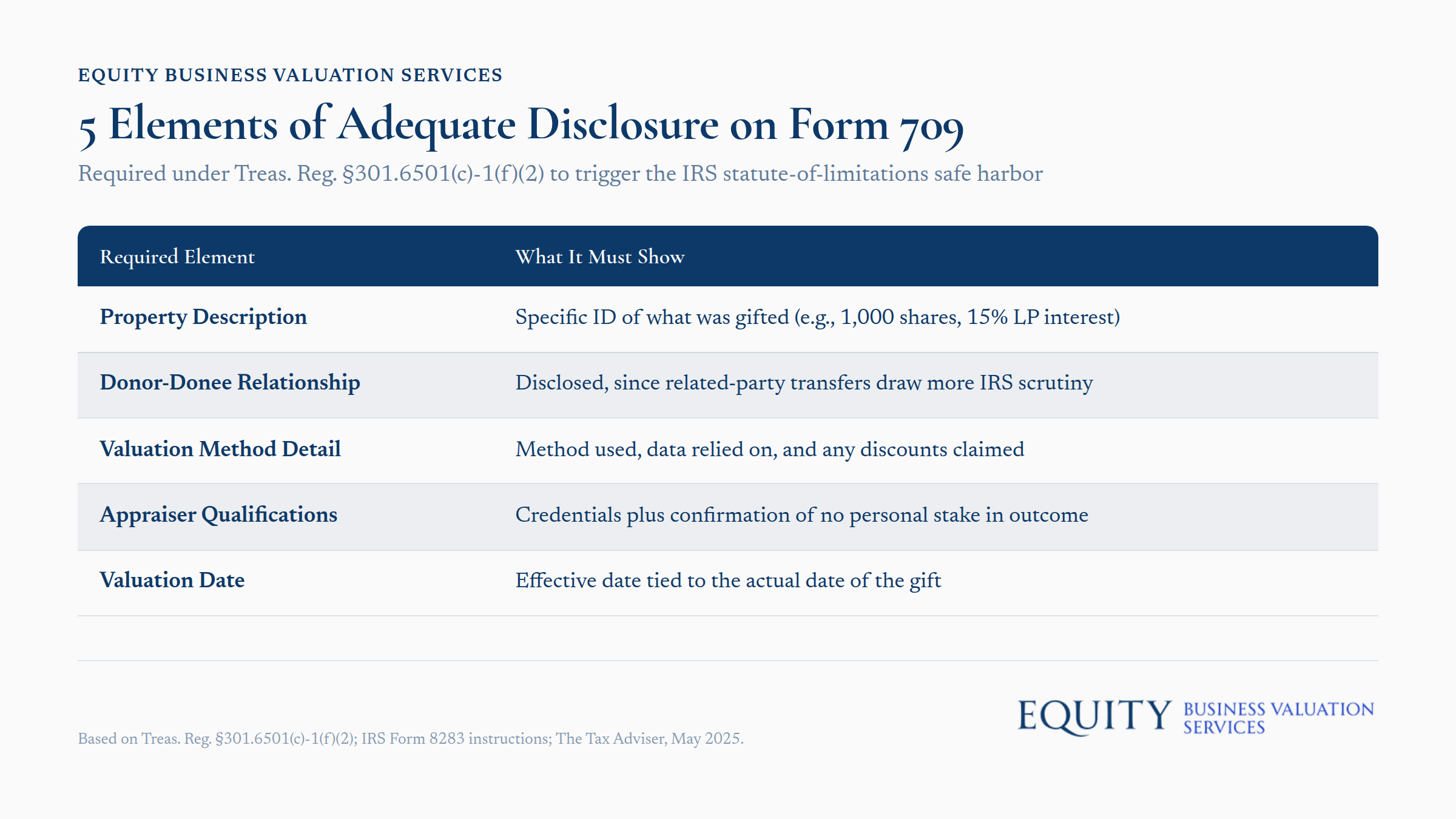
Adequate disclosure under Treas. Reg. §301.6501(c)-1(f)(2) means the gift tax return includes enough detail about the transferred property and the valuation method that the IRS can evaluate the reported value without asking for more. It is a safe harbor, not a suggestion. Meeting it is what limits how long the IRS can come back and challenge the number.
A return that qualifies for the safe harbor generally needs to show the following:
- A description of the transferred property specific enough to identify exactly what was gifted, whether that is 1,000 shares of non-marketable stock or a 15% limited partner interest.
- The relationship between the donor and the recipient, since related-party transfers draw more scrutiny.
- A detailed explanation of the valuation method, including the financial data relied on and any discounts claimed, such as a discount for lack of marketability or a minority interest discount.
- The appraiser's qualifications and a statement of independence, confirming the person valuing the gift has no personal stake in the outcome.
- The effective valuation date, tied to the actual date of the gift.
The IRS's own Form 8283 instructions repeat the underlying statutory trigger for charitable gifts: a qualified appraisal is required once claimed value exceeds $5,000 for a single item or a group of similar items. Gift tax returns don't share that exact dollar trigger, but practitioners generally use the same documentation standard voluntarily, because it's the only version of "proof" the adequate disclosure regulation actually recognizes, as reporting-standards commentary on gift tax filings has noted in recent guidance on adequate disclosure requirements.
How a Qualified Appraisal Starts the Three-Year Statute of Limitations
Under IRC §6501, the IRS generally has three years from the filing date to challenge a return. For gift tax returns, that clock only starts running once the return meets the adequate disclosure standard. File a return with a soft, undocumented valuation, and the statute of limitations on that gift's value may never start. The IRS can, in theory, revisit the valuation of that gift decades later, often at the worst possible time: when the donor has died and the same asset's value is being reconciled against the lifetime gift tax exemption on the estate tax return.
A properly prepared, signed, and dated appraisal that meets the regulation's content requirements closes that door after three years. That is arguably the single biggest practical reason to commission a real appraisal instead of relying on an informal number, even when no specific dollar threshold technically forces the issue.
Penalty Exposure Under IRC §6662 for Getting the Value Wrong
Getting the valuation wrong on a gift tax return does not just risk a revaluation. It can trigger an accuracy-related penalty under IRC §6662, and the penalty scales with how far off the reported number turns out to be.
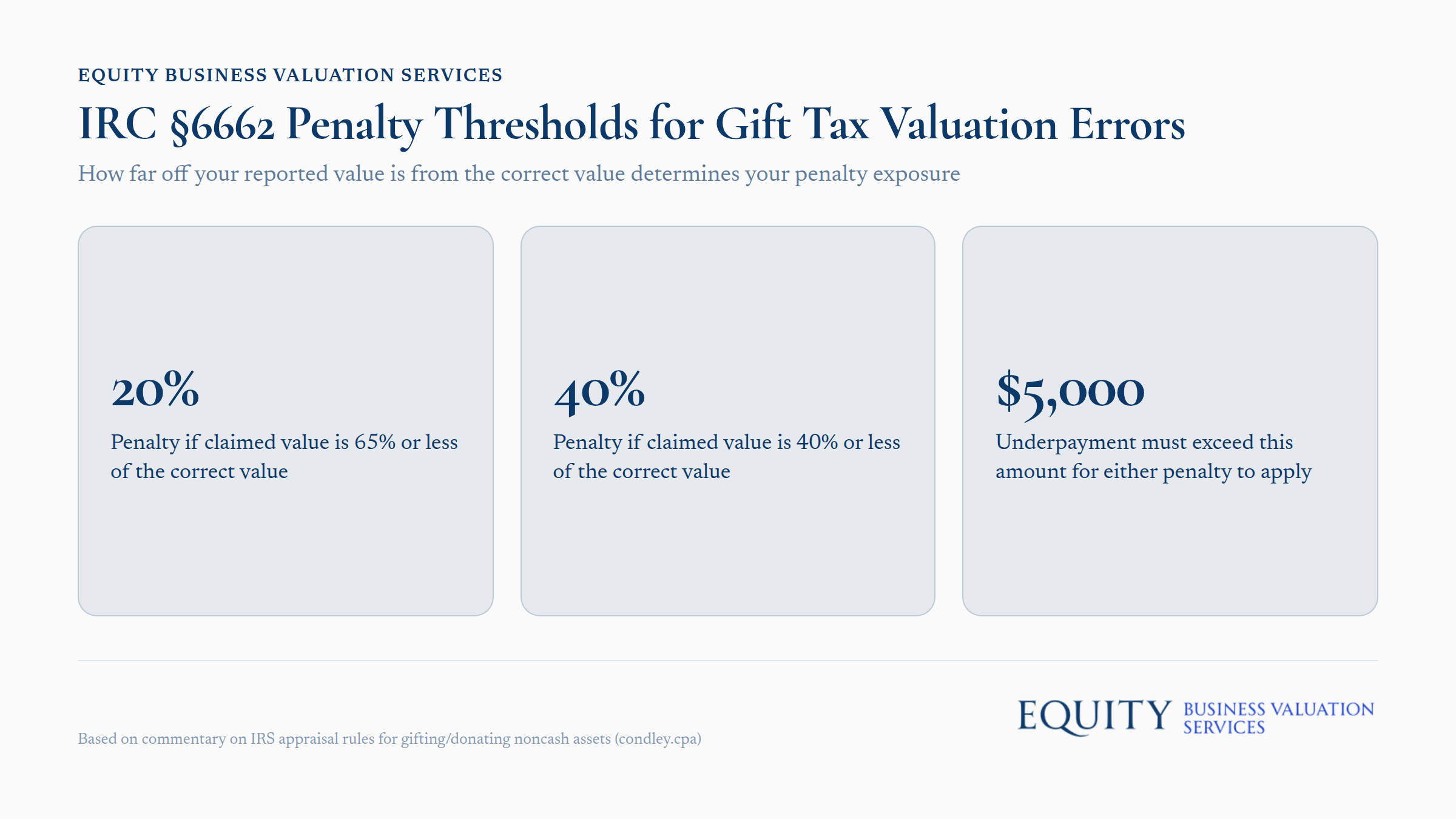
- Substantial gift tax valuation understatement: if the value claimed on the return is 65% or less of the amount later determined to be correct, a 20% penalty applies to the resulting underpayment.
- Gross valuation misstatement: if the claimed value is 40% or less of the correct value, the penalty doubles to 40% of the underpayment.
- De minimis threshold: neither penalty applies unless the resulting underpayment of tax exceeds $5,000.
A well-documented appraisal doesn't guarantee the IRS will never disagree with the concluded value. What it does is establish a reasonable, good-faith basis for the number reported, which is often the difference between an adjustment with no penalty and an adjustment with a 20% or 40% add-on. Commentary on IRS appraisal rules for gifting and donating noncash assets consistently frames the appraisal as the donor's primary defense against exactly this exposure, as CPA guidance on the subject explains.
Qualified Appraisal vs. Informal Valuation: A Worked Example
Example: Assume a parent gifts a 20% non-controlling interest in a closely held family manufacturing business to an adult child. The parent's accountant estimates the interest is worth roughly $50,000 based on a rough multiple of revenue, and the family reports that figure on Form 709.
Here's what changes depending on which route the family takes.
| Element | Informal Estimate | Qualified Appraisal |
|---|---|---|
| Preparer | Accountant or broker with no valuation credential | Independent, credentialed business valuation appraiser |
| Methodology disclosed | General reference to "a multiple of revenue" | Documented income, market, or asset approach with supporting data |
| Discounts applied | Not addressed | Marketability and minority interest discounts explained and quantified, as covered in our guide to valuation discounts in gift tax appraisals |
| Valuation date | Not certified | Tied explicitly to the gift date |
| Independence statement | None | Signed statement confirming no financial interest in the outcome |
| Meets adequate disclosure safe harbor | No | Yes |
| Statute of limitations starts | No, remains open | Yes, generally 3 years from filing |
| Penalty protection under IRC 6662 | None | Reasonable-cause defense supported |
If the IRS later determines the 20% interest was actually worth $90,000, the family that relied on the informal estimate faces a reopened valuation question with no time limit and potential exposure to the gross valuation misstatement penalty, since $50,000 is roughly 56% of $90,000, close to that 65% understatement line. The family that filed with a qualified appraisal has already closed the three-year window and has a documented, defensible basis to argue reasonable cause even if the IRS disagrees with the final number.
The same logic applies beyond business interests. A gift of fine art, a collection, or other high-value personal property runs into the identical documentation gap when the only support is a dealer's letter or an auction house estimate rather than a report prepared to meet gift tax appraisal requirements.
What the Appraisal Report Actually Needs to Document
A gift tax appraisal that is built to satisfy adequate disclosure should include, at minimum, the following:
- A full description of the gifted property, including entity structure and ownership percentage for business interests.
- The valuation date, matched to the actual date of transfer.
- The appraiser's qualifications and a statement of independence from the donor and recipient.
- The valuation methodology and underlying data, including financial statements relied upon and any comparable transactions or comparable company data used.
- Any discounts claimed, with the rationale and supporting analysis behind each one.
- A signed certification of the appraiser's conclusion of value.
For business interests and family entity gifts, this typically means engaging a valuation professional early, well before the gift is completed, since the appraisal generally needs to reflect the value as of the transfer date and should be built into the filing timeline for Form 709 rather than added afterward. Families planning a series of gifts often ask what supporting paperwork the IRS actually expects alongside the return itself; that documentation checklist is covered in more detail in our guide on Form 709 documentation requirements.
Don't Let an Informal Number Carry the Weight of a Tax Filing
An opinion of value from a broker, dealer, or online tool might be a reasonable starting point for planning conversations, but it was never built to survive an IRS review. A qualified appraisal is. The difference shows up in three concrete ways: whether the statute of limitations ever starts running, whether a later disagreement over value comes with a 20% or 40% penalty attached, and whether the family has a documented, defensible basis to stand behind the number they filed.
Engagements for gift tax valuation are quoted as a fixed fee after the assignment is scoped, based on the complexity of the entity or asset, the completeness of available records, and the depth of analysis the intended use requires. Given what is riding on the report, that scoping conversation is worth having before the gift is made, not after the IRS asks questions about it.
This article is provided for general informational purposes only and does not constitute legal, tax, or financial advice. Readers should consult a qualified attorney or CPA regarding their specific circumstances.