
Blog
Gifting Real Estate to Family: How Tax Basis, Appraisals, and Form 709 Work Together
Gifting real estate to family members carries over the donor's tax basis instead of stepping it up, often leaving the recipient with a bigger capital gains bill than anyone expected. This guide walks through the carryover basis rules under IRC Section 1015, the dual-basis trap for depreciated property, and why a contemporaneous appraisal still matters for Form 709 reporting.
Families transfer real estate as gifts for all kinds of reasons: helping a child buy a first home, moving a vacation property out of an aging parent's estate, or restructuring ownership of a family property ahead of retirement. What most families don't anticipate is that the tax basis the recipient inherits from a lifetime gift is very different from the basis they would receive if the same property passed at death. Getting this wrong can turn a generous gift into a surprise capital gains bill years later.
How Carryover Basis Works Under IRC Section 1015
When you gift real estate during your lifetime, the recipient generally does not get a fresh basis equal to the property's current fair market value. Instead, under IRC Section 1015, the recipient takes over the donor's adjusted basis, meaning whatever the donor originally paid for the property, adjusted upward for capital improvements and downward for items like depreciation or prior casualty losses.
This is called carryover basis, and it means the built-in gain the donor was sitting on doesn't disappear. It transfers to the recipient along with the deed.
There's a wrinkle, though, for property that has actually lost value since the donor bought it. The IRS basis rules apply a dual-basis test in that situation:
- For purposes of calculating a gain on a later sale, the recipient generally uses the donor's adjusted basis.
- For purposes of calculating a loss, the recipient generally uses the property's fair market value on the date of the gift, if that value is lower than the donor's basis.
- If the eventual sale price falls between those two figures, the recipient typically recognizes neither a gain nor a loss.
Example: A parent gifts a rental house to an adult child. The parent's adjusted basis in the property is $300,000, but the property's fair market value on the date of the gift has fallen to $240,000. If the child later sells the house for $320,000, the gain is measured against the $300,000 basis, producing a $20,000 gain. If the child instead sells for $220,000, the loss is measured against the $240,000 gift-date value, producing a $20,000 loss. If the child sells anywhere between $240,000 and $300,000, there is no reportable gain or loss at all.
This dual-basis trap only shows up when the gift-date value is below the donor's basis, but it's exactly the kind of detail that gets missed without a documented appraisal pinning down that gift-date figure.
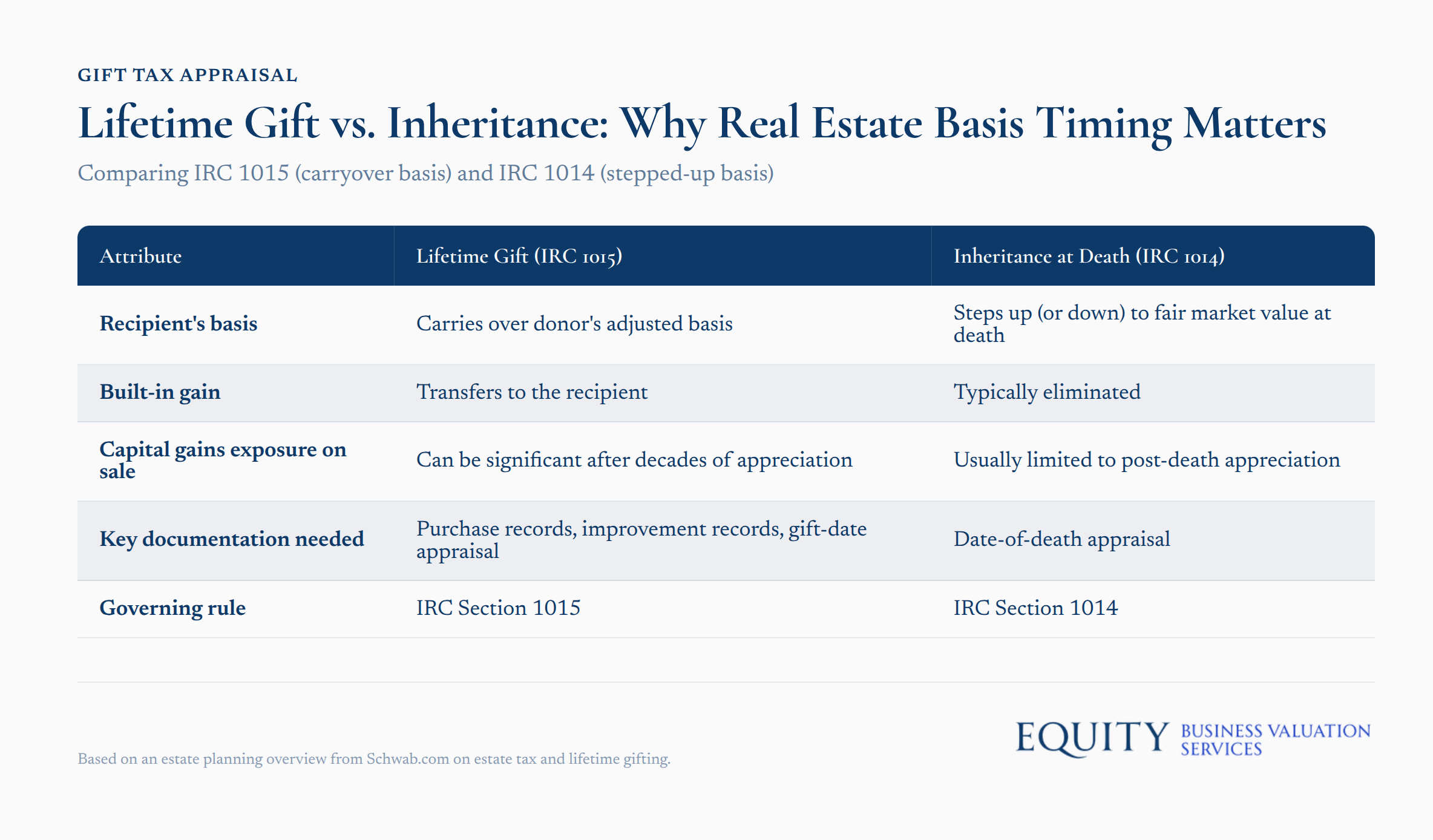
Carryover Basis vs. Stepped-Up Basis: Why Timing Changes Everything
Many families assume that gifting a property early is the tax-smart move, the same way donating other assets ahead of time often is. For appreciated real estate, it's frequently the opposite. Property that passes to an heir at death generally receives a stepped-up basis under IRC Section 1014, meaning the heir's basis resets to the property's fair market value as of the date of death, erasing the built-in gain the decedent had accumulated over decades of ownership. Property gifted during life carries the donor's old, often much lower, basis forward instead, as one estate planning overview explains.
That single distinction can change a family's long-term tax outcome by tens or hundreds of thousands of dollars, depending on how much the property has appreciated.
| Lifetime Gift (IRC 1015) | Inheritance at Death (IRC 1014) | |
|---|---|---|
| Recipient's basis | Carries over the donor's adjusted basis | Generally steps up (or down) to fair market value at death |
| Built-in gain | Transfers to the recipient | Typically eliminated |
| Capital gains exposure on sale | Can be significant if the property has appreciated for decades | Usually limited to appreciation after the date of death |
| Key documentation needed | Donor's original purchase records, capital improvement records, gift-date appraisal | Date-of-death appraisal |
| Governing rule | IRC Section 1015 | IRC Section 1014 |
This doesn't mean gifting real estate during life is always the wrong move. There are valid non-tax reasons to transfer property early, such as removing an asset from a taxable estate, avoiding probate, or simply helping a family member now rather than later. But the decision should be made with the basis consequences clearly understood, not assumed.
Why the Gift-Date Appraisal Still Matters
If basis carries over regardless of current value, it's reasonable to wonder why an appraisal at the time of the gift matters at all. It matters for three distinct reasons that have nothing to do with the carryover basis calculation itself.
First, the gift tax return itself runs on fair market value, not basis. Form 709 requires the donor to report the property's fair market value as of the gift date, and that figure determines how much of the annual exclusion and lifetime exemption the gift uses up. Our gift tax appraisal services exist precisely to establish that defensible fair market value for reporting purposes.
Second, a well-documented, qualified appraisal starts the clock on the IRS's ability to challenge the reported value. Adequate disclosure of the valuation method and supporting appraisal on a filed gift tax return generally limits how long the IRS has to dispute the number later. Without that documentation, a family can find a decades-old gift value reopened for examination far longer than expected, a point we cover in more depth in our guide to what makes a qualified appraisal distinct from a simple fair market value estimate.
Third, the gift-date appraisal is a completely separate number from the carryover basis figure, and families often conflate the two. The basis is an old number tied to the donor's original purchase price and improvement history. The appraisal is a current number tied to the gift date. Both need to be documented and both need to survive on their own, because the IRS, the recipient's eventual tax preparer, and any future buyer may all ask for them independently.
Watch out: Don't assume the donor's basis records and the gift-date appraisal are interchangeable. Keep both. The basis documentation (purchase closing statement, capital improvement receipts, depreciation schedules if the property was rented) supports the eventual sale. The appraisal supports the gift tax filing and the valuation statute of limitations.
2026 Gift Tax Exclusion, Lifetime Exemption, and When Form 709 Is Required
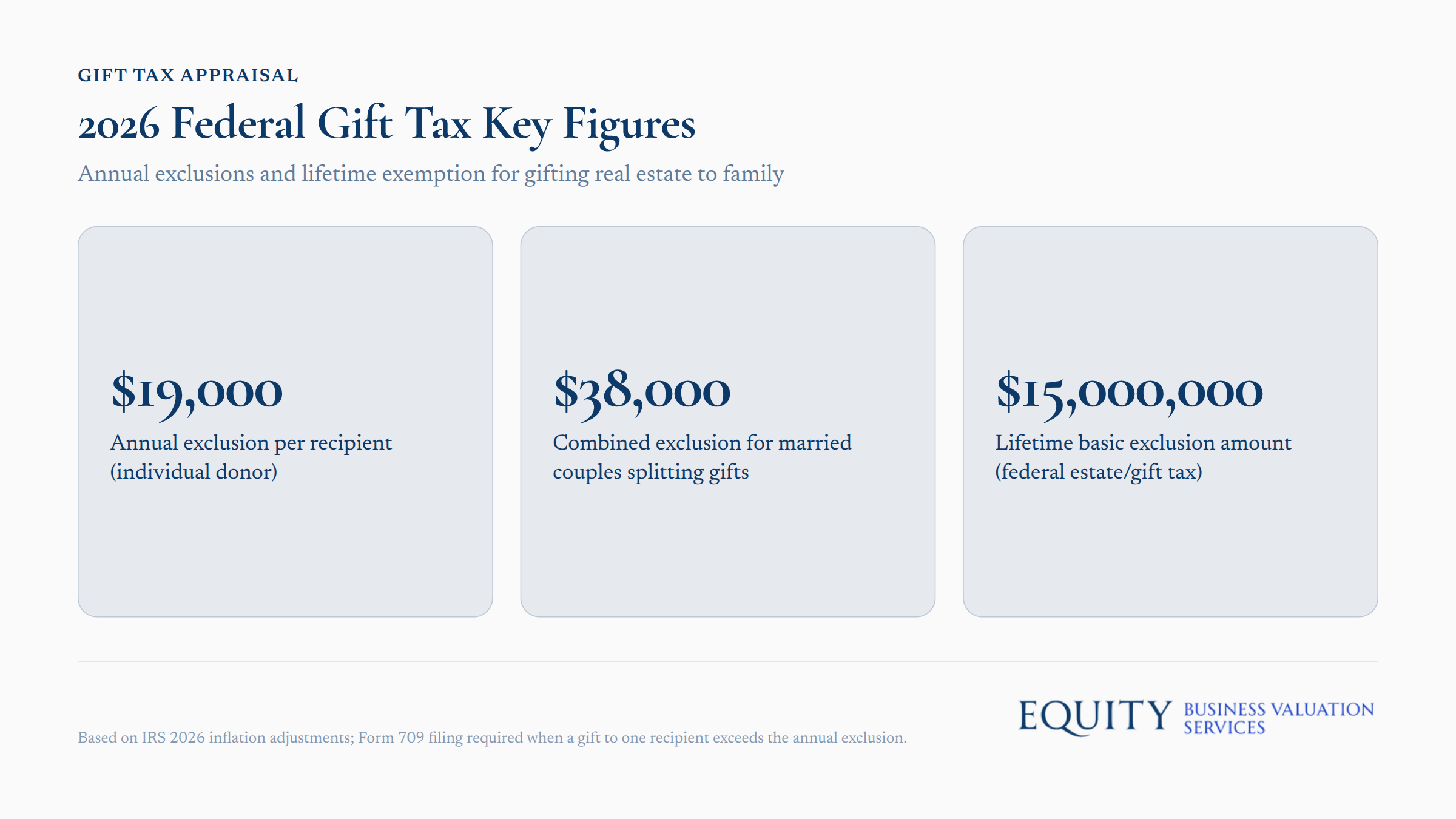
For calendar year 2026, the federal gift tax annual exclusion is $19,000 per recipient, and a married couple electing to split gifts can give up to $38,000 to a single recipient without using any lifetime exemption, according to the IRS's 2026 inflation adjustments. The annual exclusion applies to each recipient separately and only to present-interest gifts, a category that generally includes an outright transfer of real estate but excludes gifts involving trusts or retained rights, which require separate analysis.
The federal basic exclusion amount, the lifetime exemption that shields larger gifts from actual gift tax, rises to $15,000,000 for 2026. Since the federal gift and estate tax systems are unified, prior taxable gifts reduce the exemption still available to a donor, so a family with a history of large gifts may have less headroom than the headline figure suggests. The annual exclusion is a per-gift, per-year allowance; the lifetime exemption is a running total across a donor's entire giving history.
A donor generally must file Form 709 for any calendar year in which a gift of real estate to one recipient exceeds the annual exclusion amount. Filing is required based on the size and nature of the transfer, not on whether any actual tax ends up being owed. A gift of a $500,000 property, for instance, is reportable in full for the year of transfer; it cannot be spread across multiple years just because the asset is hard to divide. Review our documentation checklist for Form 709 and the current estate and gift tax exemption figures before you file.
Real Estate Gifts vs. Cash Gifts: A Different Set of Rules
Gifting cash carries none of this complexity: there's no basis to track and no appraisal to obtain, since dollars don't appreciate or carry a cost basis the way property does. Real estate is a fundamentally different transfer, with its own basis mechanics, valuation requirements, and documentation burden that cash gifts simply don't trigger.
Steps to Take Before You Transfer the Deed
Families planning a real estate gift should work through a short checklist before any paperwork is signed.
- Get the property appraised as of the gift date. A qualified, contemporaneous appraisal establishes the fair market value used on Form 709 and creates the documentation that supports the valuation if the IRS ever asks questions later.
- Gather the donor's original basis records. Purchase closing statements, records of capital improvements, and depreciation schedules (if the property was rented or used in business) all need to travel with the gift so the recipient can calculate gain or loss correctly down the road.
- Confirm whether Form 709 is required. If the gift to any one recipient exceeds the annual exclusion for the year, the donor needs to file, even if no actual tax is due.
- Consult a CPA or estate attorney before the deed transfers. State transfer taxes, recording requirements, and the interaction between the gift and the donor's broader estate plan are all legal and tax questions that sit outside the scope of a valuation report.
Our team prepares the fair market value appraisal families need to support accurate gift tax reporting and basis documentation. We don't handle the deed transfer, closing, or legal filing itself; that work belongs with the family's attorney or CPA, and we coordinate alongside them. If you're planning a gift of real estate and need a defensible, well-documented valuation for Form 709, request an appraisal and our team will help you scope exactly what the filing requires.
This article is provided for general informational purposes only and does not constitute legal, tax, or financial advice. Readers should consult a qualified attorney or CPA regarding their specific circumstances.