
Blog
The Gift Tax Valuation Penalty: What Happens if You Underreport Value on Form 709
Filing Form 709 on time doesn't protect you from a gift tax valuation penalty if the number you reported turns out too low. This guide breaks down the 20% and 40% penalty tiers under IRC Section 6662, the $5,000 underpayment floor, and how a qualified appraisal supports a reasonable cause defense.
Filing Form 709 on time does not protect you if the value you reported on it turns out to be wrong. The IRS has a specific penalty regime for gifts that are undervalued on a return that was actually filed, separate from the penalties for failing to file a gift tax return at all. Get the number wrong by enough, and the gift tax valuation penalty can add 20% or 40% on top of the tax you underpaid, and in some cases the gift stays open to IRS challenge indefinitely.
What Counts as a Gift Tax Valuation Understatement?
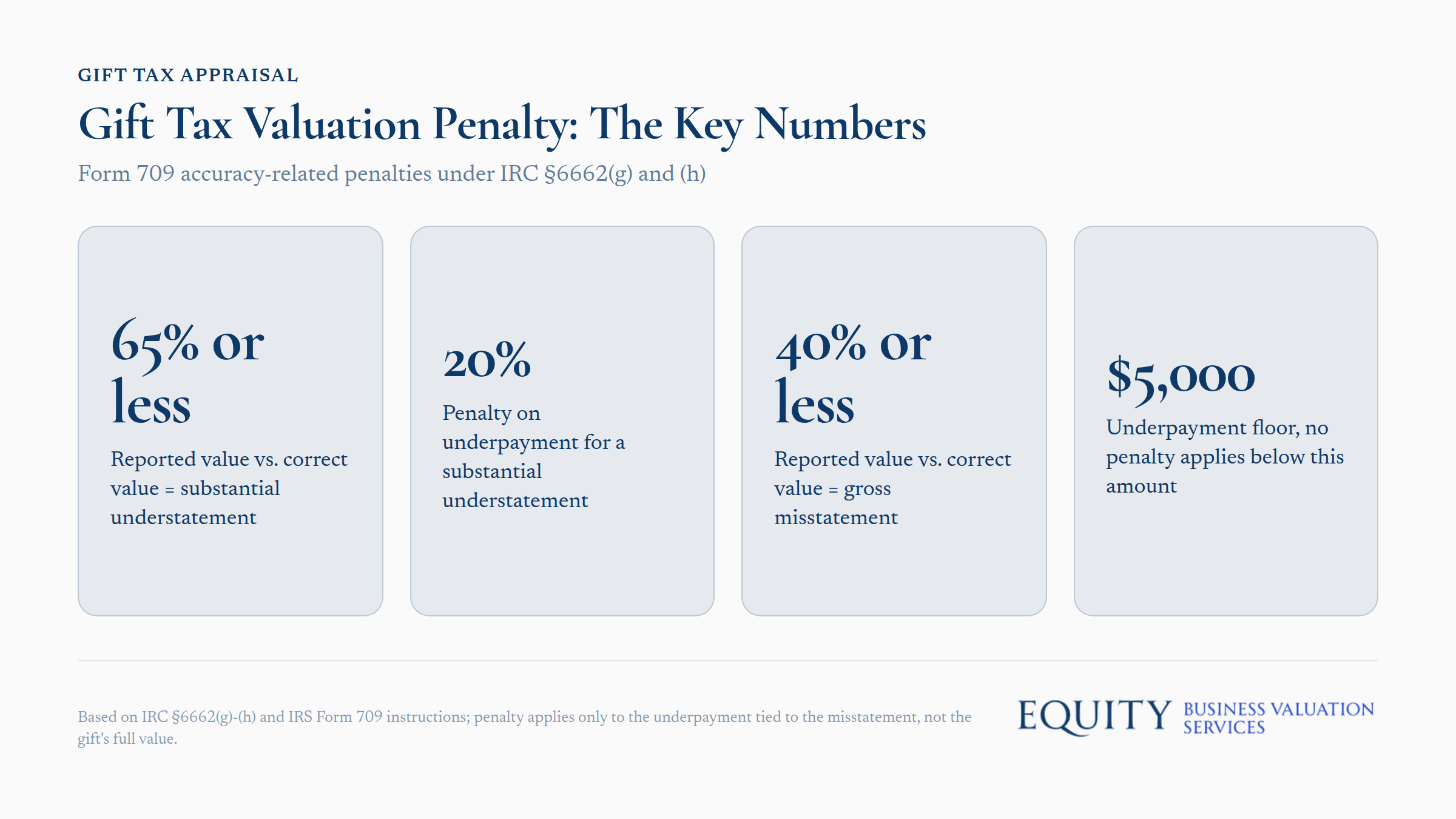
A gift tax valuation understatement becomes "substantial" when the value reported on Form 709 is 65% or less of the value the IRS later determines to be correct. It becomes "gross" when the reported value drops to 40% or less of the correct value. Both tiers only trigger a penalty if the resulting gift tax underpayment exceeds $5,000.
These thresholds come from IRC Section 6662(g) and (h), the accuracy-related penalty provisions that apply to estate and gift tax valuation misstatements. The IRS instructions for Form 709 specifically warn filers that an understated value resulting in an underpayment can carry its own penalty, separate from interest and separate from any failure-to-file penalty. Reported values are compared against whatever the IRS (often relying on its own expert or appraiser) later concludes is the correct fair market value:
- Substantial valuation understatement: reported value is 65% or less of the correct value; a 20% penalty applies to the portion of the underpayment attributable to the understatement.
- Gross valuation misstatement: reported value is 40% or less of the correct value; a 40% penalty applies instead, again limited to the underpayment tied to the misstatement.
- $5,000 floor: no valuation penalty applies at all unless the underpayment caused by the misstatement exceeds $5,000, regardless of which tier the ratio falls into.
The Tax Notes analysis of how the gross valuation misstatement penalty applies to gift transactions makes the same point that practitioners often miss: the penalty is calculated on the underpayment, not on the value of the gift itself. A large gift with a modest valuation gap can owe far less penalty than a small gift with an extreme one. Our gift tax appraisal services exist largely to keep clients out of this territory in the first place, by documenting a defensible value before the return is ever filed.
How the Penalty Is Calculated on a Real Gift
The math runs in three steps: find the underpayment, confirm it clears $5,000, then apply the 20% or 40% rate depending on which tier the reported value falls into. The wider the gap between reported and correct value, the steeper the penalty rate as well as the dollar amount.
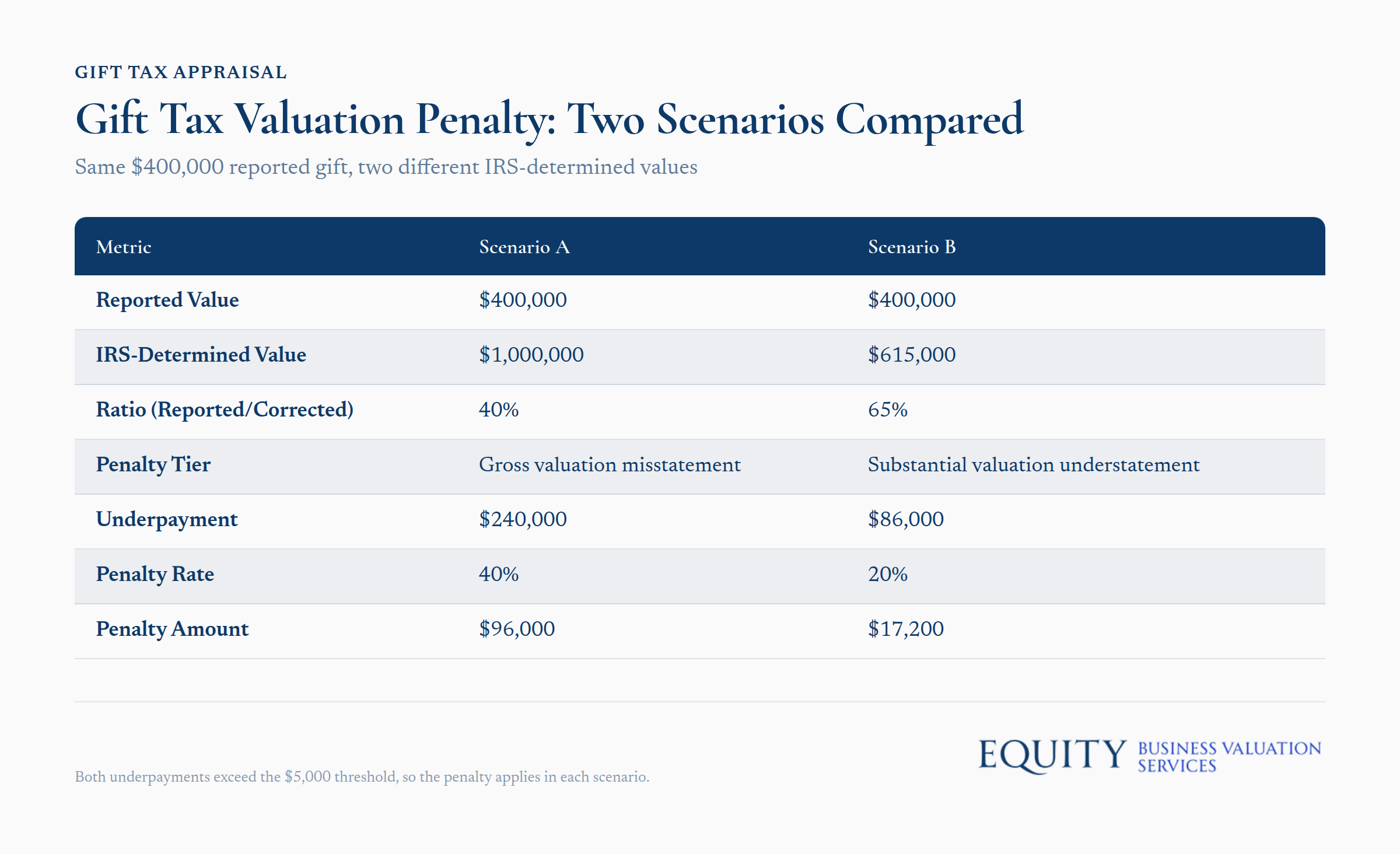
Example: A donor gifts a minority interest in a family business and reports it on Form 709 at $400,000. Assume the gift is fully taxable (no remaining exemption) at a 40% marginal gift tax rate, and the IRS later challenges the value through its own appraisal.
| Scenario | Reported Value | IRS-Determined Value | Ratio | Tier | Underpayment | Penalty |
|---|---|---|---|---|---|---|
| A | $400,000 | $1,000,000 | 40% | Gross valuation misstatement | $240,000 | $96,000 (40%) |
| B | $400,000 | $615,000 | 65% | Substantial valuation understatement | $86,000 | $17,200 (20%) |
In Scenario A, the reported value is exactly 40% of the corrected value, so the gross misstatement tier applies. The $600,000 undervaluation, taxed at 40%, produces a $240,000 underpayment, and the 40% penalty adds another $96,000 on top of the corrected tax and interest. In Scenario B, the reported value sits at roughly 65% of the corrected figure, landing in the substantial understatement tier at a 20% rate, for a $17,200 penalty. Both underpayments clear the $5,000 floor, so neither donor has an argument that the penalty simply does not apply.
Key takeaway: the penalty percentage is not the whole story. A modest valuation gap on a large gift can still produce a six-figure penalty once the underpayment is large enough, which is why the ratio between reported and corrected value matters as much as the dollar amount of the gift itself.
Filing on Time Doesn't Start the Clock Without Adequate Disclosure
A filed Form 709 only starts the normal three-year statute of limitations on assessment if the gift is "adequately disclosed" under Treasury Regulation 301.6501(c)-1(f). Miss that bar, even on a timely, otherwise complete return, and the IRS can revisit the valuation at any point in the future.
Adequate disclosure means the return has to do more than just report a number. Practitioner guidance on Form 709 preparation, including the legal and technical issues involved in preparing a gift tax return, lays out what the disclosure needs to contain:
- A complete description of the transferred property and any consideration received in exchange.
- Identification of the donor, the donee, and the relationship between them.
- For gifts in trust, the trust's EIN and a description of its material terms, or a copy of the trust instrument itself.
- A detailed explanation of the valuation method used, including the financial data relied on for a closely held or non-marketable interest, and the rationale behind any discounts claimed.
Watch out: these two exposures stack. A gift that is both undervalued and inadequately disclosed can face the accuracy-related penalty described above and remain open to assessment indefinitely, since the three-year clock never starts running on that transfer.
This kind of scrutiny rarely comes out of nowhere. For the specific documentation gaps and valuation red flags that tend to draw IRS attention in the first place, see what triggers an IRS audit of a gift tax appraisal.
The Reasonable Cause Defense: Why the Appraisal Itself Matters
IRC Section 6664(c) provides a reasonable cause and good faith exception to the accuracy-related penalty, but claiming it is not automatic. The exception generally requires the donor to show a good faith investigation of the property's value, and for most gifts of real estate, business interests, or other hard-to-value property, that means a qualified appraisal from a qualified appraiser.
The practical value of a properly scoped appraisal shows up here directly. Analysis of gift tax valuation planning points to the same conclusion: donors who rely on a documented, professionally prepared valuation are in a far stronger position to argue reasonable cause than donors who simply picked a number. The IRS has long maintained guidance describing what a gift tax appraisal report should contain, including the valuation approach used, the data relied on, and the qualifications of the appraiser, and reports that follow that structure hold up better under audit than informal estimates. Our guide to what makes an appraisal qualified for gift tax purposes walks through those requirements in more detail.
The appraisal itself carries risk too. Under IRC Section 6695A, an appraiser who prepares a valuation knowing it will be used on a return, and whose figure results in a substantial or gross valuation understatement, can face a separate penalty: the greater of 10% of the underpayment or $1,000, capped at 125% of the fee the appraiser was paid. That penalty does not apply if the appraiser can show the value was more likely than not correct, which is exactly why credentialed appraisers document their methodology as carefully as they do.
Pro tip: if the gift involves a business interest, request a fixed-fee quote before the engagement starts. Standard business valuation reports typically start around $4,500, and IRS-qualified reports built for filings like Form 709 typically start around $5,500, with the final fee scoped to the complexity of the entity and the depth of analysis the assignment requires.
This Is Different from Failing to File Form 709
Everything above assumes a return was filed. The failure-to-file penalty under IRC Section 6651 is a separate rule that applies when a gift tax return is not filed at all, or is filed late without reasonable cause, and it is calculated as a percentage of unpaid tax per month of delinquency rather than as a percentage tied to a valuation ratio. A donor can owe the valuation penalty described in this article, the failure-to-file penalty, or both, depending on the facts. They are not interchangeable, and confusing the two often leads donors to underestimate how much exposure a single mistake on Form 709 can create.
Protecting the Value You Report
The gift tax valuation penalty exists to discourage donors from picking a convenient number instead of a supportable one. A 20% or 40% penalty on top of a corrected tax bill, potentially with no statute of limitations protecting the gift at all, makes the cost of guessing far higher than the cost of a proper appraisal at the time of the gift.
Our appraisers prepare USPAP-compliant valuations built specifically for gift tax filings, with the documentation and methodology disclosure that both the adequate disclosure rules and the reasonable cause defense depend on. If you are planning a gift of a business interest, real estate, or other hard-to-value asset, request an appraisal before you file.
This article is provided for general informational purposes only and does not constitute legal, tax, or financial advice. Readers should consult a qualified attorney or CPA regarding their specific circumstances.