
Blog
How Form 709 Establishes Gift Tax Basis and Starts the IRS Statute of Limitations
Filing Form 709 does more than report a taxable gift: a well-documented fair market value on the return can start the IRS's three-year assessment clock and shield that valuation from a later challenge. This guide explains gift tax basis under Form 709, the carryover basis rule, and why adequate disclosure depends on a defensible appraisal.
Most people think of Form 709 as paperwork required only when a gift crosses the annual exclusion amount. That's true as far as it goes, but it misses the more useful function the form serves for attorneys, CPAs, and families making large or hard-to-value gifts. Filing Form 709, even voluntarily, creates a documented record of the donor's adjusted basis and the gift's fair market value, and under the right conditions it starts the clock on how long the IRS has to dispute that value. For gifts of closely held business interests, art, or other assets without a public price tag, that clock matters far more than most people realize.
Our gift tax appraisal team works with attorneys and fiduciaries on exactly this kind of filing: assets where the value isn't obvious from a receipt or a brokerage statement, and where a defensible number on the return does real legal work.
How Carryover Basis Works Under IRC Section 1015
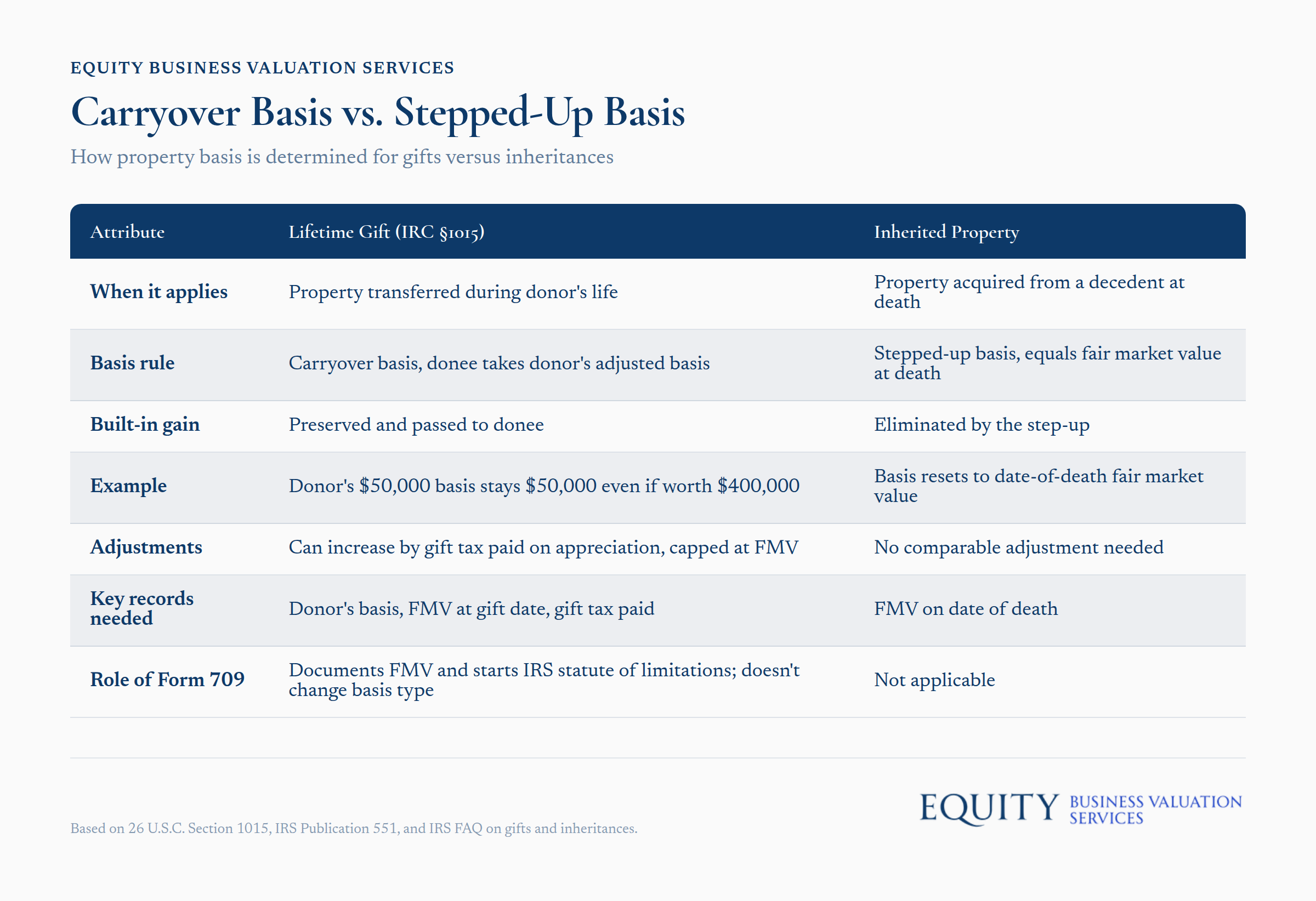
Gifted property does not get a fresh basis when it changes hands. Under 26 U.S.C. Section 1015, a donee generally takes the donor's adjusted basis in the property, a rule commonly called carryover basis. If the donor paid $50,000 for a business interest and it's worth $400,000 at the time of the gift, the donee inherits that same $50,000 basis, not the current fair market value.
This is a fundamentally different mechanism from what happens at death. Property acquired from a decedent typically receives a stepped-up basis equal to its fair market value on the date of death, eliminating the built-in gain that accrued during the decedent's lifetime. The IRS Publication 551 guidance on the basis of assets lays out both rules side by side: carryover basis for lifetime gifts, stepped-up basis for inherited property. Filing Form 709 with a well-supported fair market value does not convert carryover basis into stepped-up basis. It never changes what the donee's basis actually is. What it does change is how solid the record of that gift's value becomes, and how long the IRS can second-guess it.
There's a related wrinkle worth noting for anyone doing the math on paper: if the donor paid gift tax on a post-1976 transfer, the donee's basis can be increased by the portion of that gift tax attributable to the property's appreciation, though the increase can never push basis above the fair market value at the time of the gift. Figuring this correctly requires three numbers on file: the donor's adjusted basis, the fair market value at the date of the gift, and any gift tax actually paid, a combination the IRS FAQ on gifts and inheritances confirms is exactly what a donee needs to compute basis correctly down the road.
Why File Form 709 Even Below the Reporting Threshold?
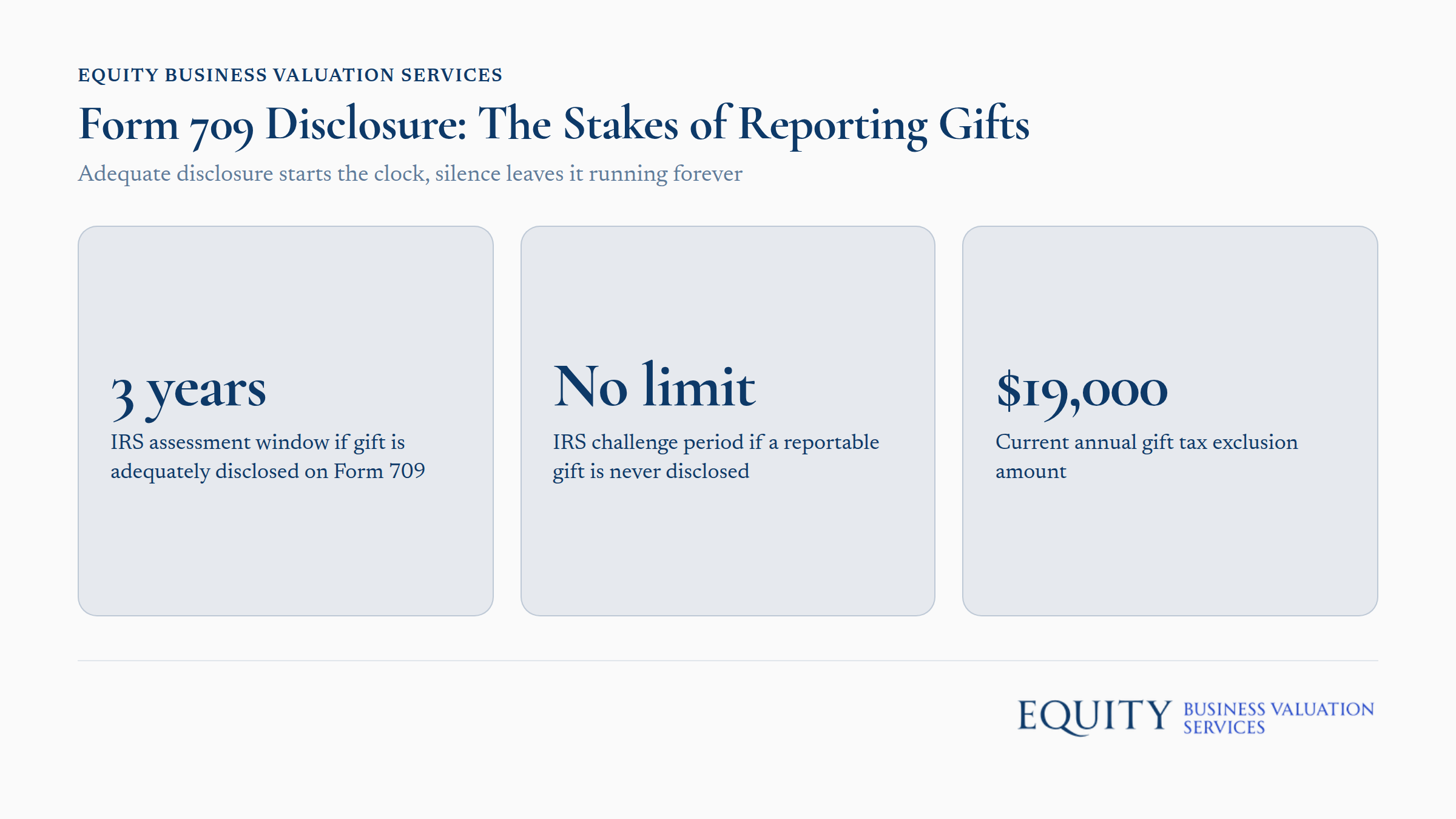
For 2025 and 2026, the annual gift tax exclusion is $19,000 per donee, and the IRS FAQ on gift taxes confirms that gifts above this amount to any one person generally require a Form 709 filing unless another exclusion applies. Married couples electing to split gifts can effectively double that figure per donee.
Here's the part that surprises a lot of clients: a donor can file Form 709 for a gift that falls under the threshold, or that qualifies for an exclusion entirely, purely to put a fair market value on record. This is a common planning move for two reasons. First, it documents the valuation used, which matters if the same asset (a minority interest in a family company, a collection, a piece of real property held outside the business) is gifted again in stages over multiple years. Second, and more importantly, it can start the IRS's standard assessment window running on that specific valuation, so the number doesn't stay open to challenge indefinitely.
The IRS instructions for Form 709 direct the filer to report the donor's adjusted basis in the gifted asset on Schedule A, alongside the description of the property and its value at the date of the gift. Knowing what documentation the IRS expects on that schedule is worth reviewing before the return is prepared; our guide on what documentation Form 709 requires walks through it in more detail.
Adequate Disclosure: The Rule That Actually Starts the Clock
Filing Form 709 alone does not automatically start the assessment statute of limitations running on a gift's value. The gift has to be adequately disclosed on the return. That means the return must include enough detail, a description of the transferred property, the identity of the donor and donee, and an explanation of the valuation method (including any appraisal relied upon), that the IRS could reasonably evaluate the reported value if it chose to. This standard traces back to federal tax law governing the statute of limitations on gift tax assessments.
When a gift is adequately disclosed, the general rule under that same body of law is that the IRS has three years from the filing date to challenge the reported value. After that window closes, the valuation is generally locked in, even if the IRS later disagrees with the number or the asset's value turns out to have been understated. This is precisely why the strategy exists: a family transferring a stake in a closely held business wants that valuation dispute resolved within a defined window, not left open for a decade.
What Happens If a Reportable Gift Goes Undisclosed
If a gift that should have been reported is never disclosed on a Form 709 at all, there is no three-year clock. The IRS retains the ability to challenge that transfer's valuation with no time limit whatsoever, at any point in the future, including after the donor's death when the same asset's earlier gift value affects the estate tax calculation. That open-ended exposure is the practical cost of skipping the filing or under-disclosing the details on a return that should have included them.
Why a Qualified Independent Appraisal Matters for This Strategy
Adequate disclosure isn't a formality you can satisfy with a rough estimate written into Schedule A. The protection only holds up if the reported value is credible enough that the IRS could evaluate it and choose not to challenge it. That's a documentation standard, and it's exactly what a qualified, independent appraisal is built to satisfy: a defined valuation methodology, a description of the property, and a reasoned conclusion of value that a reviewer (or a court, years later) can actually follow.
This matters most for assets that don't have a ready market price. A minority interest in a family limited partnership or closely held corporation, a fine art collection, or a portfolio of collectibles all require professional judgment to value, and all are exactly the kind of assets the IRS is most likely to revisit if the disclosure looks thin. Our qualified appraisal for gift tax purposes guide covers how a properly supported fair market value differs from a number pulled from an online estimate or a broker's opinion.
Our engagements in this area are quoted as a fixed fee before work begins, scoped to the complexity of the asset and the intended use of the report. As a general reference point, business valuation engagements prepared for IRS-qualified purposes typically start from $5,500, with more complex ownership structures or multiple entities running higher; personal property appraisals for gift tax purposes start from $295 for an IRS-qualified report, scaling with the number of items and research required. Fees are driven by the scope of the assignment, never by the value of the asset being appraised.
Pro tip: If a closely held business interest or a valuable personal property collection is likely to be gifted in stages over several years, get the first appraisal built to hold up on its own. A well-documented valuation approach used consistently across multiple gifts makes each subsequent Form 709 filing stronger, not just the first one.
When This Strategy Matters Most
Voluntary Form 709 filing with a supporting appraisal isn't necessary for every gift. It earns its cost when the asset is large, hard to value, or likely to draw scrutiny later. Common scenarios include:
- Gifts of closely held business interests, where minority discounts, lack-of-marketability adjustments, or control premiums all affect the reported value and are exactly the kind of judgment calls the IRS is inclined to question years after the fact.
- Gifts of fine art, collectibles, or other personal property with values that depend on condition, provenance, and market comparables rather than a quoted price.
- Multi-year gifting programs where the same asset class is transferred repeatedly and a consistent, defensible valuation methodology protects every year's filing, not just the current one.
- Gifts made in anticipation of a later estate, where the reported gift value will also affect the taxable estate calculation and any dispute could resurface at death.
In each of these cases, the combination of a qualified appraisal and a properly disclosed Form 709 does two jobs at once: it satisfies the IRS's documentation expectations today, and it starts the countdown on how long that documentation can be second-guessed.
Building a Defensible Record Before You File
The basis mechanics behind a gift don't change based on how well the gift is documented; carryover basis under Section 1015 applies whether or not a return is ever filed. What changes is the strength of the record supporting the reported value and, in cases where the gift required reporting, whether the IRS's window to challenge that value ever closes. For gifts of businesses, art, or collections where the number isn't obvious, an independent appraisal is what turns a Form 709 filing from a compliance exercise into a durable piece of estate planning.
If you're preparing a Form 709 for a closely held business interest or high-value personal property and need a defensible fair market value on record, request an appraisal from our team before the return is filed.
This article is provided for general informational purposes only and does not constitute legal, tax, or financial advice. Readers should consult a qualified attorney or CPA regarding their specific circumstances.