
Blog
How Valuation Discounts Work in Gift Tax Appraisals for FLP and LLC Interests
Valuation discounts in gift tax appraisals can meaningfully reduce the taxable value of a gifted FLP or LLC interest, but only when the discount is properly supported and disclosed. This guide walks through DLOC, DLOM, Form 709 disclosure rules, and the case law that decides whether discounts hold up.
Gifting an interest in a family limited partnership or LLC is one of the most common estate planning moves for families with a closely held business, a real estate portfolio, or an investment holding company. The appeal is straightforward: a minority, non-marketable interest is worth less than its pro-rata share of the entity's total value, and a properly supported valuation discount reflects that reality on the gift tax return. But the IRS scrutinizes these discounts closely, and the rules for disclosing them on Form 709 are unforgiving of shortcuts. This guide covers how discount for lack of control (DLOC) and discount for lack of marketability (DLOM) work, what the disclosure regulations require, and what the courts have said about which entities actually earn the discount.
What Is a Valuation Discount in a Gift Tax Appraisal?
A valuation discount is a percentage reduction applied to the pro-rata value of a gifted interest to reflect the practical limitations of owning a minority, illiquid stake rather than outright control of an asset. In gift tax appraisals for FLP and LLC interests, two discounts typically apply, and they are calculated separately before being combined.
The discount for lack of control (DLOC) accounts for the fact that a minority owner cannot force a distribution, direct the sale of entity assets, or dictate management decisions. The discount for lack of marketability (DLOM) accounts for the fact that an interest in a closely held entity cannot be sold quickly or easily, unlike a share of publicly traded stock. Both discounts are grounded in real economic differences between owning 100% of an asset and owning a restricted slice of it, and both must be supported with financial data and recognized valuation methodology, not asserted as a flat percentage.
Discount for Lack of Control vs. Discount for Lack of Marketability
The two discounts address different problems and are supported by different evidence. The table below summarizes how appraisers typically distinguish them in a gift tax appraisal.
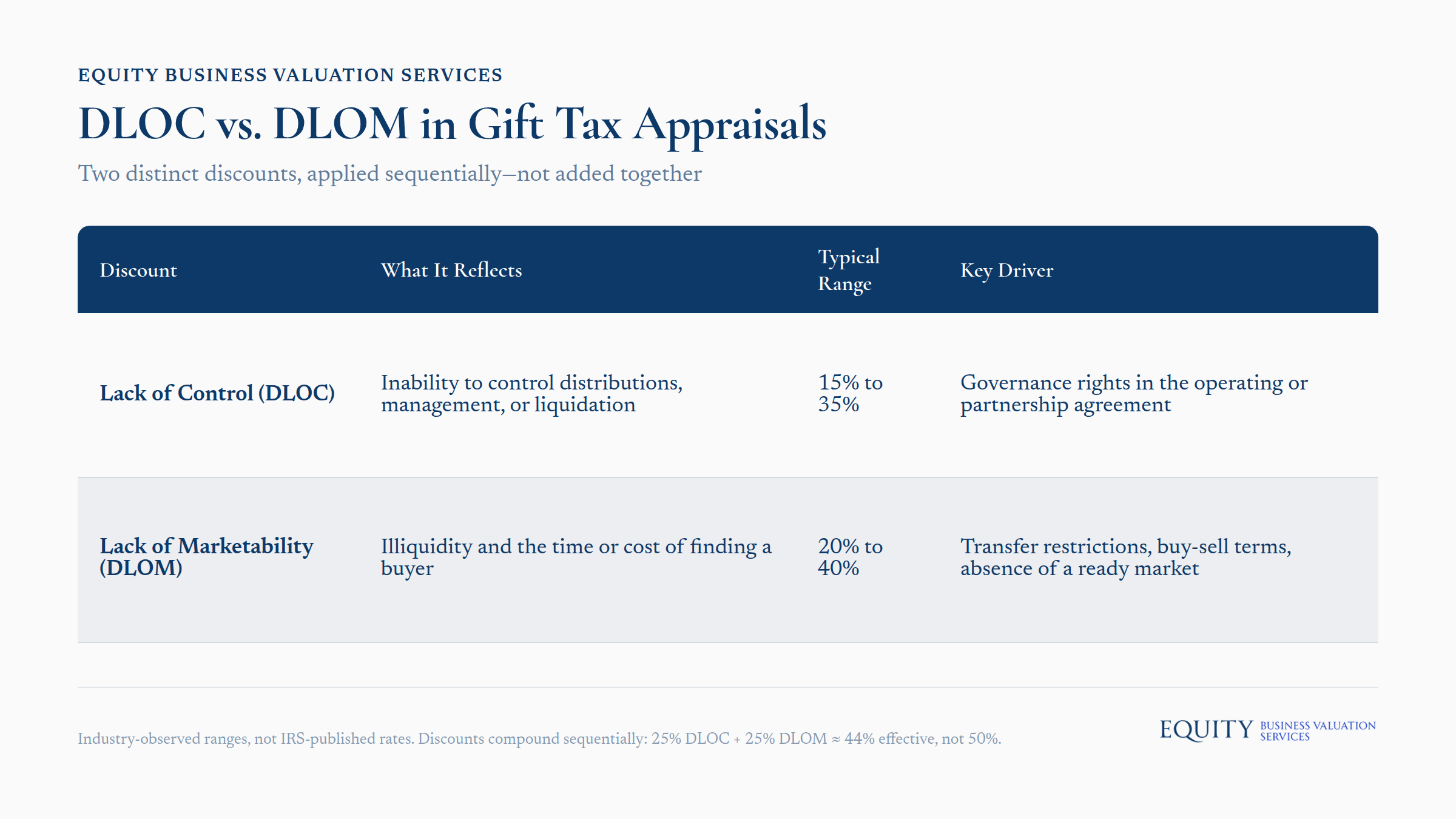
Discount | What It Reflects | Typical Range | Key Driver |
|---|---|---|---|
Lack of Control (DLOC) | Inability to control distributions, management, or liquidation | 15% to 35% | Governance rights in the operating or partnership agreement |
Lack of Marketability (DLOM) | Illiquidity and the time or cost of finding a buyer | 20% to 40% | Transfer restrictions, buy-sell terms, absence of a ready market |
These are industry-observed ranges, not IRS-published rates, and the IRS does not fix a discount percentage anywhere in its guidance. Every discount has to be derived from the entity's own restrictions, financial performance, and comparable market data.
The discounts are applied sequentially rather than added together, which matters because the combined effect compounds. A 25% DLOC followed by a 25% DLOM does not produce a 50% total discount; it produces an effective discount closer to 44%, since the second discount is applied to the already-reduced value.
A Worked Example: Gifting a Minority LLC Interest
Suppose a parent owns 100% of a family LLC holding a portfolio of rental real estate, appraised at a control value of $4,000,000. The parent gifts a 25% non-managing interest to an adult child.
Pro-rata value of the gifted interest: 25% of $4,000,000 = $1,000,000
Apply a 20% DLOC: $1,000,000 x (1 - 0.20) = $800,000
Apply a 25% DLOM: $800,000 x (1 - 0.25) = $600,000
Reported taxable gift value: $600,000
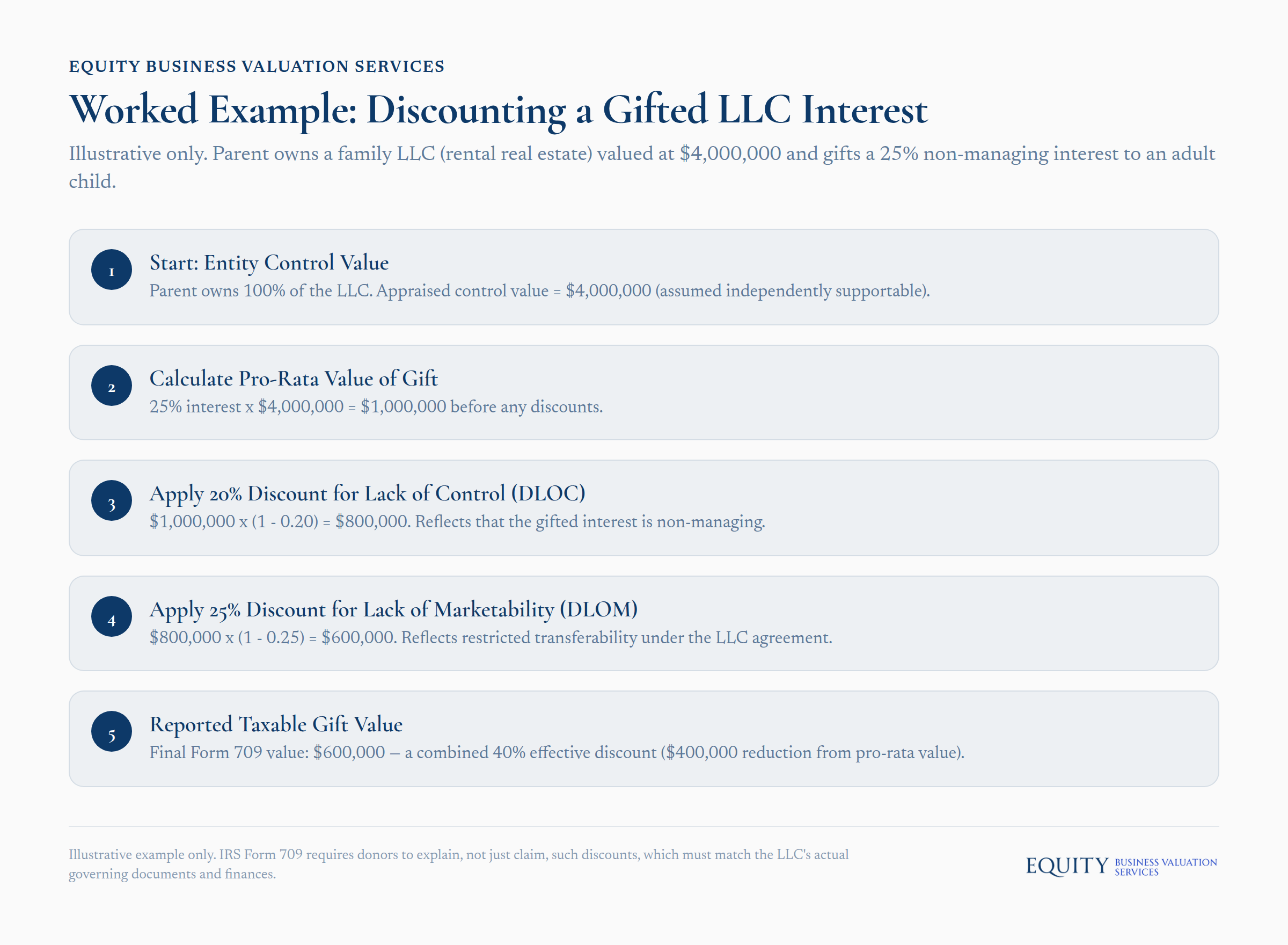
The combined effect of the two discounts reduces the reportable gift from $1,000,000 to $600,000, an effective discount of 40%. That $400,000 difference is exactly the kind of adjustment the IRS Form 709 instructions require the donor to explain, not just claim. After the annual exclusion for the donee is applied, the remainder of the gift is charged against the donor's lifetime exemption, so getting the discounted value right has a direct and lasting effect on how much exemption is used.
Watch out: A discount that isn't tied to the entity's actual governing documents and financial history is the fastest way to invite an IRS challenge. If the LLC agreement doesn't actually restrict transfers or distributions the way the appraisal assumes, the discount won't survive review.
Form 709 Disclosure Requirements for Discounted Gifts
Form 709 requires every donor claiming a valuation discount to disclose it directly on Schedule A. The form asks whether the reported value of any gift reflects a discount for lack of marketability, minority interest or lack of control, a fractional interest in real estate, blockage, or any other reason, according to the Form 709 instructions. If the answer is yes, the donor must attach an explanation covering the basis for the discount and its dollar and percentage impact.
That explanation isn't a formality. Practitioner analysis of the disclosure rules notes that the attachment needs to state the fair market value of 100% of the entity without any discount, the percentage interest being transferred, and the final discounted value being reported, so the IRS can trace the math from control value to discounted gift value in one place, as described in detailed disclosure guidance.
Why Adequate Disclosure Under Treas. Reg. 301.6501(c)-1(f)(2) Matters
Adequate disclosure starts the three-year statute of limitations on the IRS's ability to challenge the value of a gift. Miss the disclosure requirements and the IRS can revisit the valuation years, even decades, later.
Under Treasury Regulation 301.6501(c)-1(f)(2), a gift of an interest in a non-actively-traded entity is adequately disclosed only if the return includes either a qualified appraisal or a detailed description of the valuation method used, according to analysis of the adequate disclosure rule. That description has to identify the financial and other data relied on (commentary points to roughly five years of financial history for an operating entity), any restrictions considered in the valuation, and the specific discounts claimed, per reporting guidance on qualified appraisals.
A bare dollar figure with "discount applied" noted in the margin does not meet this standard. The description needs enough detail that another appraiser, or an IRS examiner, could reconstruct how the number was reached. This is precisely what a formal, USPAP-compliant appraisal report is built to do, and it's why practitioners increasingly treat a qualified appraisal, rather than an internal estimate, as the safer path whenever a discount is involved, as outlined in practical guidance on IRS appraisal rules.
Pro tip: File the disclosure even on gifts that fall below the annual reporting threshold if a discount was applied. Practitioners commonly recommend filing Form 709 anyway to start the statute of limitations running and to lock in the entity's baseline valuation for future gifts.
Where IRC Section 2704 Stands Today
IRC Section 2704 lets the IRS disregard certain restrictions on liquidation or redemption in family-controlled entities when valuing an interest, if those restrictions could be removed by the family itself rather than being imposed by an outside party or state law, per background on valuation discount rules.
In 2016, Treasury proposed regulations under Section 2704 that would have sharply curtailed DLOM and other discounts for family-controlled entities. Those proposed regulations drew heavy public comment and were never finalized; they were later withdrawn and have not been replaced. As of today, Section 2704 remains on the books in its original, narrower form, and the expansive 2016 proposal is not in effect. That means existing case law and standard valuation methodology, not a stricter regulatory overlay, still govern how discounts on family-controlled entities are evaluated.
What Estate of Strangi and Estate of Kelley Teach About Legitimate Business Purpose
Much of the case law shaping how the IRS and courts view FLP and LLC discounts comes from estate tax disputes, but the reasoning applies directly to gift tax appraisals of the same entities.
In Estate of Strangi v. Commissioner, the Tax Court found that a family limited partnership formed shortly before the decedent's death lacked any real non-tax business purpose. The decedent retained effective control and economic benefit over the assets, and the entity existed primarily to generate valuation discounts. The court applied Section 2036 to pull the partnership assets back into the estate at full, undiscounted value, wiping out the intended discount.
Estate of Kelley v. Commissioner reached a different result on similar facts. There, the court found the partnership had genuine business purposes, consolidating investment management, protecting assets, and facilitating an orderly transition of control to younger family members, and the senior family member did not retain control or enjoyment inconsistent with a real transfer. The discounts were upheld.
Taken together, these cases point to a consistent two-part test that any FLP or LLC seeking to support a discount should be able to pass: the entity needs to operate like a genuine business or investment vehicle, with real governance and observed formalities, and it needs a documented non-tax purpose beyond simply lowering a gift tax bill.
The IRS's Long History with Minority and Fractional Interest Discounts
The IRS has recognized fractional and minority interest discounts in specific cases for decades, most notably in disputes over jointly owned art and collectibles, where an estate owning a partial interest in a piece argued that a buyer would demand a steep discount to purchase an unmarketable fractional share. However, there is still no official written IRS policy establishing when or how much of a fractional interest discount applies. Decisions rest on the specific facts and evidence in each case, which is exactly why a well-documented, methodologically sound appraisal carries so much weight when a discount is challenged.
Why a Qualified Business Appraiser Matters for Defensibility
Key takeaway: A discount that isn't backed by a credentialed appraisal, built on real financial data and tied to the entity's actual restrictions, is one of the first things an IRS examiner will challenge, and one of the hardest things to defend after the fact.
The appraisal has to do more than land on a defensible number. It has to document the reasoning well enough to satisfy the adequate disclosure requirements, withstand review years after the gift is made, and hold up if the case ends up in Tax Court. Appraisers working in this space typically hold credentials such as those from the American Society of Appraisers or the National Association of Certified Valuators and Analysts, and every report should be prepared in accordance with the Uniform Standards of Professional Appraisal Practice published by The Appraisal Foundation.
Our gift tax appraisal team prepares USPAP-compliant business valuations for FLP and LLC interests, with the documentation depth that Treas. Reg. 301.6501(c)-1(f)(2) requires and the analytical rigor that holds up under IRS review.
Getting the Discount Right Before You File
A valuation discount can meaningfully reduce the taxable value of a gifted FLP or LLC interest, but the benefit only holds if the discount is grounded in the entity's real governance structure, supported by sound methodology, and disclosed in the detail Form 709 demands. Skipping any one of those steps risks losing the discount, the statute of limitations protection, or both.
If you're planning a gift of a closely held business or investment entity interest, get the appraisal and the disclosure right the first time. Request an appraisal from our team to get a defensible, USPAP-compliant valuation built for exactly this purpose.
This article is provided for general informational purposes only and does not constitute legal, tax, or financial advice. Readers should consult a qualified attorney or CPA regarding their specific circumstances.