
Blog
Valuation Discounts for Estate and Gift Taxes on Closely-Held Interests and FLPs
Valuation discounts for estate and gift taxes reduce the pro-rata fair market value of closely-held business stock, FLP interests, and fractional ownership when reported on Form 706 and Form 709. This guide explains how DLOM and minority interest discounts are built, stacked, and documented so they hold up under IRS review.
Closely-held business stock, family limited partnership units, and fractional ownership stakes rarely sell for their simple pro-rata share of the whole. When these interests are gifted or land in an estate, the IRS requires fair market value, and fair market value has to account for the fact that a minority, illiquid slice of an asset is worth less to a buyer than a controlling, freely tradable one. That gap is where valuation discounts come in, and getting them wrong (or asserting them without support) is one of the fastest ways to draw scrutiny on a Form 706 or Form 709 filing.
This guide walks through what a valuation discount actually is, what drives the two discounts that show up most often (lack of marketability and lack of control), how they apply differently across business stock, FLP interests, and fractional real estate or entity interests, and what the IRS expects to see when you report them. Our business valuation team prepares these appraisals for attorneys, CPAs, and families navigating exactly this kind of transfer.
What Is a Valuation Discount Under IRC 2031 and 2512?
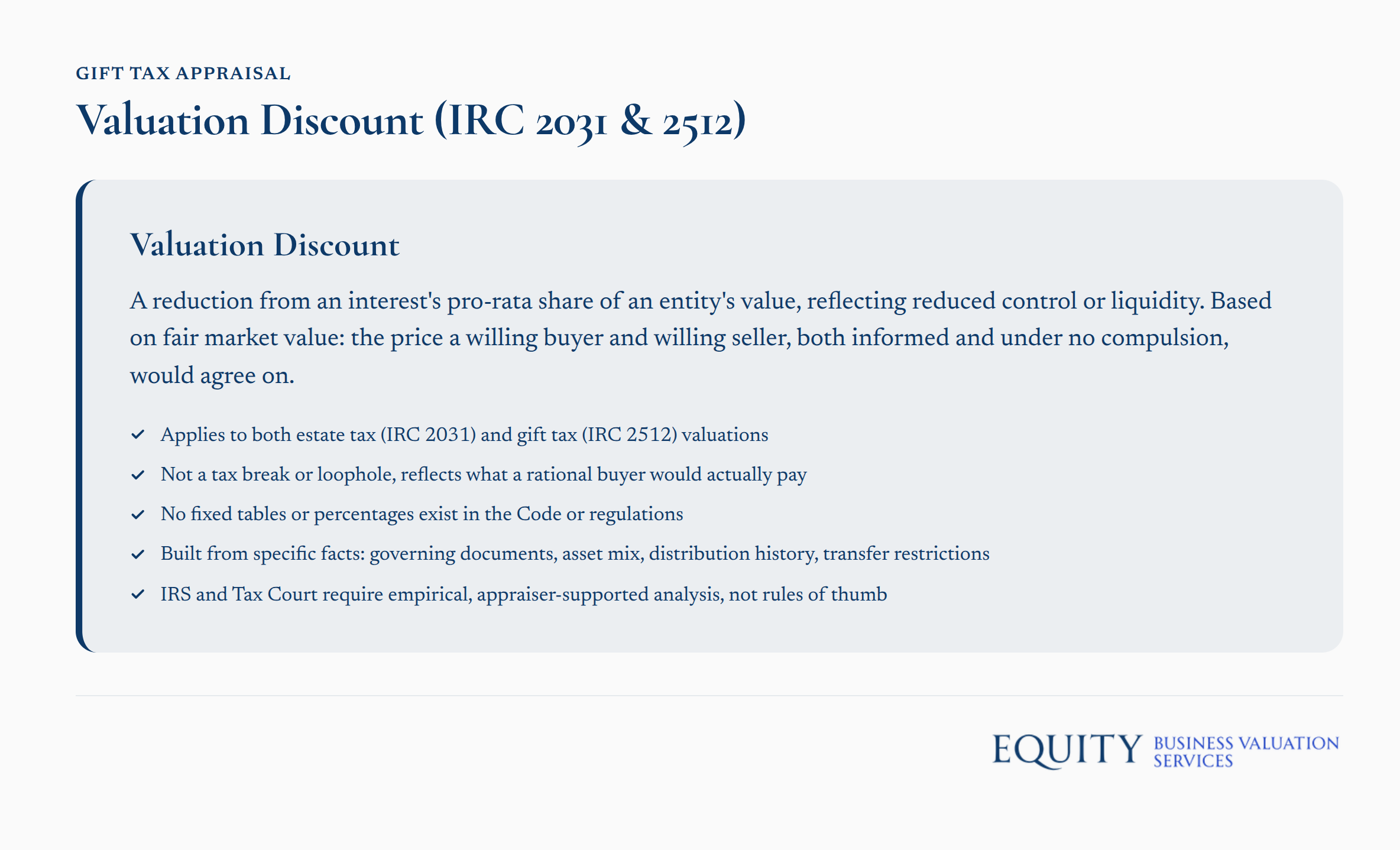
A valuation discount is a reduction from an interest's pro-rata share of the underlying entity's value, applied because the specific interest being valued carries less economic power or liquidity than the whole. It is not a tax break or a loophole; it is simply what a rational buyer would actually pay.
Both estate tax valuation under IRC Section 2031 and gift tax valuation under IRC Section 2512 use the same standard: fair market value, defined as the price at which property would change hands between a willing buyer and a willing seller, neither under compulsion to act and both reasonably informed of the relevant facts. This willing buyer, willing seller framework has anchored IRS valuation practice for decades and is the reason discounts exist at all. A hypothetical buyer of a 10% limited partnership interest is not buying 10% of the partnership's control or its ability to sell assets on demand; they are buying a passive, illiquid slip of paper, and they will not pay full pro-rata value for it.
The Code and Treasury regulations do not publish discount tables or fixed percentages. Every discount has to be built from the specific facts of the interest: the entity's governing documents, its asset mix, its distribution history, and any transfer restrictions. That is why the IRS and the Tax Court have consistently required an empirical, appraiser-supported analysis rather than a flat number pulled from a rule of thumb.
Discount for Lack of Marketability: What Drives It
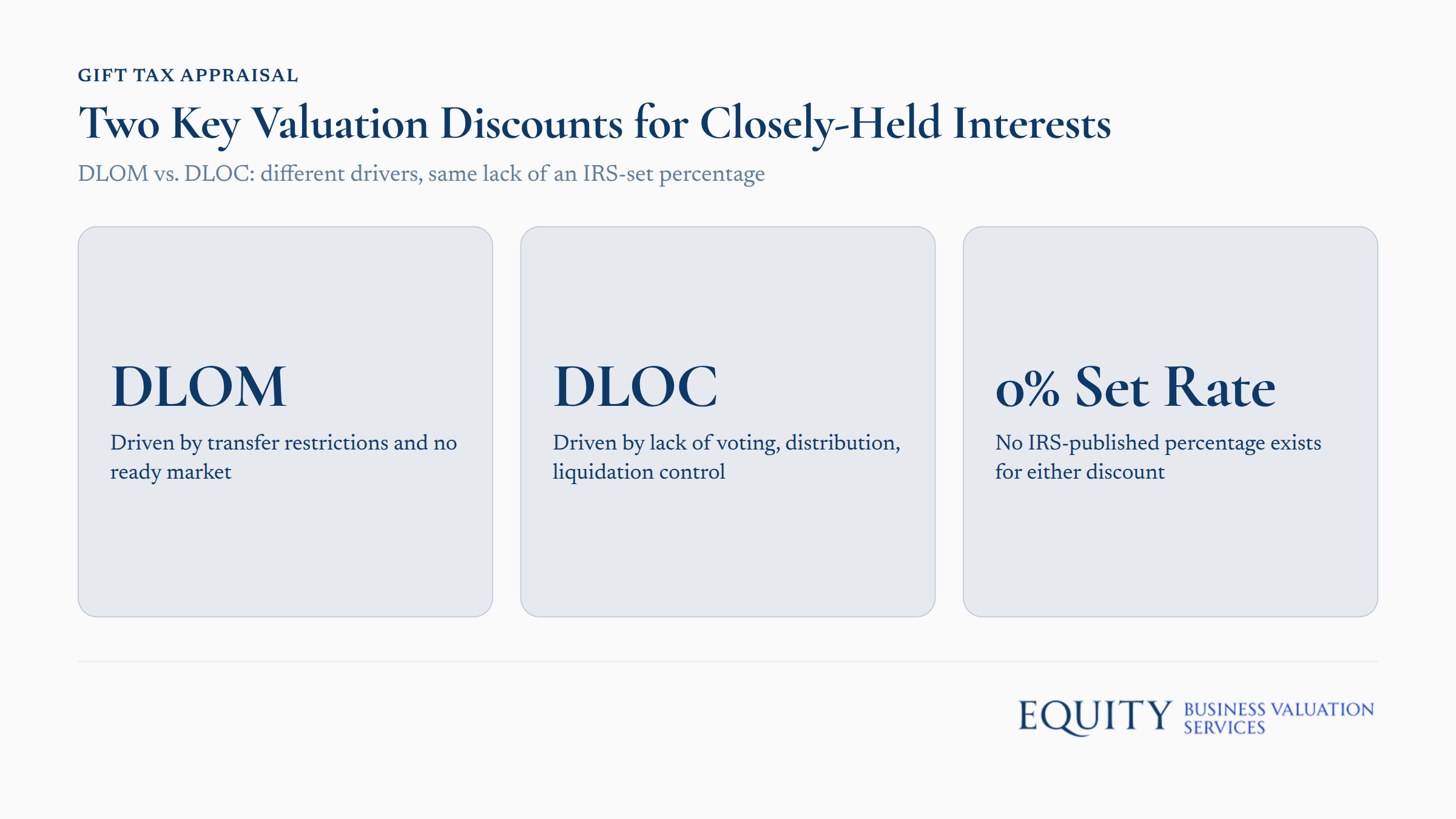
The discount for lack of marketability (DLOM) compensates a buyer for the fact that an interest cannot be quickly converted to cash. Unlike publicly traded stock, an interest in a closely-held business, an FLP, or a fractional real estate holding usually has no ready market, no listed price, and often a governing agreement that restricts who it can be sold to and when.
Several factors typically drive the size of a DLOM:
- Transfer restrictions: Partnership agreements or operating agreements that require partner consent, offer rights of first refusal, or bar outside transfers altogether make an interest harder to sell.
- Absence of a ready market: There is no exchange or dealer network for a 15% interest in a family business, so a buyer has to be found privately, which takes time and negotiation.
- Expected holding period: The longer a buyer expects to hold the interest before any liquidity event (a sale of the company, a partnership dissolution, a property sale), the larger the discount a rational buyer will demand.
- Distribution policy: An entity that rarely distributes cash to owners makes an illiquid interest even less attractive, widening the discount.
Appraisers typically ground DLOM conclusions in empirical studies that compare prices of restricted or pre-IPO shares against their freely traded counterparts, adjusting for the size, industry, and specific restrictions of the subject interest. Industry data generally places DLOM in a wide range depending on those facts, but no fixed percentage applies automatically to any interest; the number has to come from the entity's own characteristics. For a deeper look at how appraisers build this discount, see our discussion of the discount for lack of marketability in gift and estate tax valuations.
Discount for Lack of Control: The Minority Interest Discount
The discount for lack of control (DLOC), often called the minority interest discount, reflects the simple fact that owning a piece of something is not the same as controlling it. A limited partner or minority shareholder cannot force a distribution, cannot compel a sale or liquidation of assets, and cannot unilaterally change management or strategy.
What typically drives the size of a DLOC:
- Voting rights: An interest with no voting power, or voting power far short of a majority, carries a larger discount than one with meaningful influence over decisions.
- Distribution authority: If the general partner or managing member has sole discretion over whether and when to distribute cash, minority holders bear real economic risk that discounts have to reflect.
- Liquidation rights: An inability to force dissolution or a buyout locks a minority holder into the entity's timeline, not their own.
- Governance protections: Some agreements grant minority holders limited veto rights or information rights, which can narrow (though rarely eliminate) the discount.
Appraisers commonly build DLOC conclusions from studies that compare what buyers pay for controlling stakes in public companies against what minority shares of the same companies trade for, adjusted for the governance terms of the specific interest being valued. As with DLOM, there is no IRS-published percentage; the conclusion has to be supported by the entity's actual governing documents and financial history. Our guide to valuing a minority interest in a family business for gift tax purposes covers the mechanics in more depth.
How DLOM and DLOC Stack Across Business Stock, FLP Interests, and Fractional Ownership
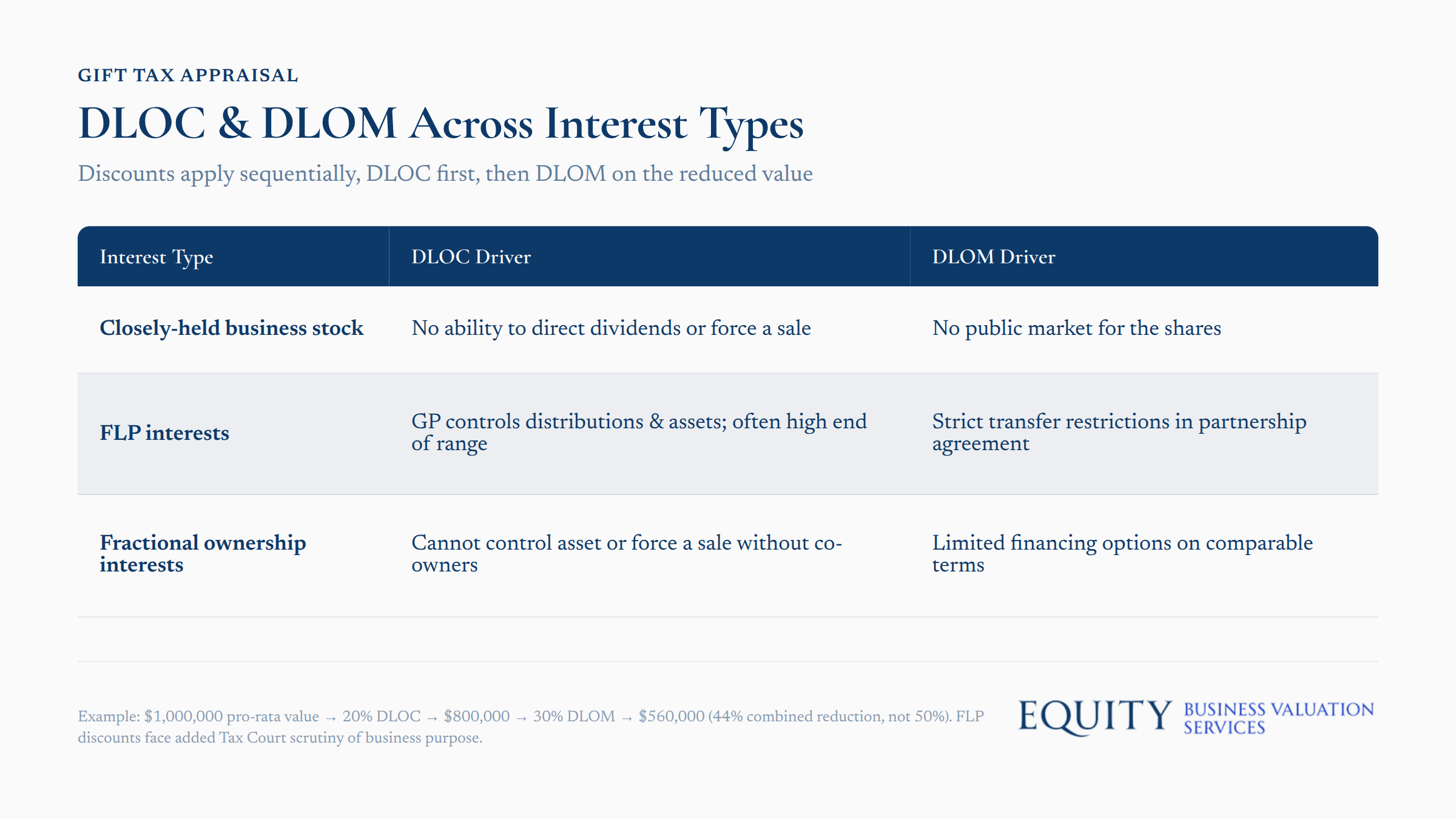
DLOC and DLOC are applied sequentially, not added together. An appraiser first applies the lack of control discount to the interest's pro-rata share of net asset value, then applies the lack of marketability discount to that already-reduced figure.
Example: A limited partnership interest represents a pro-rata share of $1,000,000 in underlying net asset value. A 20% DLOC brings that to $800,000. A 30% DLOM applied to the $800,000 result brings the concluded value to $560,000, a combined reduction of 44% from the pro-rata figure, not 50%.
The two discounts show up differently depending on the type of interest being transferred.
- Closely-held business stock: A minority shareholder in a family corporation typically faces both a DLOC (no ability to direct dividends or force a sale) and a DLOM (no public market for the shares), with the size of each tied to the company's bylaws, dividend history, and any buy-sell agreement.
- Family limited partnership interests: Limited partners almost always carry both discounts, often at the higher end of typical ranges, because partnership agreements frequently impose strict transfer restrictions and give the general partner broad control over distributions and asset decisions. The Tax Court has scrutinized FLPs closely and has denied or reduced discounts where the partnership appeared to exist mainly to generate a tax result rather than to serve a legitimate business purpose, which is why the underlying documentation matters as much as the math.
- Fractional ownership interests: A fractional interest in real estate or a closely-held asset (an heir who inherits a one-fifth interest in a piece of property, for example) faces a similar logic even without a partnership wrapper: a buyer cannot control the asset, cannot force a sale without the cooperation of the other owners, and often cannot obtain financing on comparable terms, all of which support a discount from the pro-rata value.
Reporting Discounts on Form 706 and Form 709
An estate reporting a discounted interest on Form 706 cannot simply enter the reduced number. Where the estate answers yes to the question about interests in a partnership, unincorporated business, LLC, or closely held corporation, the Form 706 instructions require an attached statement identifying the total effective discount taken, expressed as a percentage, along with the relevant schedule and item number. That single disclosure line is often the first thing an examiner checks.
The same instructions define a closely held business for purposes of the Section 6166 estate tax installment election: the interest must exceed 35% of the adjusted gross estate, and ownership thresholds apply, generally 20% or more of partnership capital (with no more than 45 partners) or 20% or more of a corporation's voting stock. These thresholds matter beyond the discount question itself, since they determine whether an estate can spread its tax payment over time, and estates relying on a discounted valuation should confirm their appraisal supports both purposes consistently.
Form 709 does not carry an identical disclosure line, but the same fair market value standard applies to lifetime gifts of partnership interests, LLC interests, closely-held stock, and fractional interests. Filing an adequately disclosed gift tax return, complete with a qualified appraisal, is also what starts the statute of limitations running on the IRS's ability to challenge the reported value later. For more on that mechanic, see how Form 709 establishes gift tax basis and starts the statute of limitations.
Why a Qualified Appraisal Matters for IRS Defensibility
Discounts that are asserted without support get challenged, and discounts that are built on empirical analysis tend to hold up. Courts have accepted well-documented DLOC and DLOM conclusions in numerous cases involving closely-held businesses and FLPs, but they have also reduced or denied discounts where the appraisal evidence was thin, the partnership lacked a real business purpose, or the analysis relied on a flat percentage instead of the entity's actual facts. A publication of the American Institute of CPAs' The Tax Adviser has covered how heavily FLP valuations have been litigated on exactly these grounds.
A defensible discount rests on the entity's own documents and numbers: the partnership or operating agreement, historical distributions, transfer restrictions, and a comparison against empirical studies of control premiums and marketability discounts, sequenced correctly rather than simply added together. General guidance in the valuation field walks through how the asset, income, and market approaches feed into this analysis before any discount is layered on, and that groundwork is what separates a defensible conclusion from a guess.
Our appraisers hold credentials with organizations such as the ASA and NACVA, and every report is prepared in accordance with USPAP. For gift and estate tax engagements involving a business interest, our fee for an IRS-qualified business valuation starts at $5,500, and a fractional interest engagement starts at $5,000, both quoted as a fixed fee after we scope the entity's complexity, the number of interests involved, and the depth of analysis the discount will require. Fees are never based on the value we conclude, only on the scope of the work.
If you are preparing to gift or report an interest in a closely-held business, an FLP, or a fractional asset, request an appraisal before the transfer or the filing deadline, not after the IRS has already asked questions.
This article is provided for general informational purposes only and does not constitute legal, tax, or financial advice. Readers should consult a qualified attorney or CPA regarding their specific circumstances.