
Blog
How to Report a Gift of Closely Held Stock or Business Equity on Form 709
Reporting a business equity gift on Form 709 takes more than writing a number on Schedule A: the entity description, the adequate disclosure statement, and the qualified appraisal all have to line up or the IRS statute of limitations never starts to run. This guide walks through the mechanics so the return holds up if it's ever reviewed.
A gift of closely held stock, LLC units, or a partnership interest is one of the trickiest things to put on a tax return, not because the form is complicated but because the description and support behind the number carry so much weight. Get the entity description, the disclosure language, and the appraisal wrong and the IRS can reopen the gift's valuation indefinitely. Get them right and the three-year clock starts ticking the day you file. Here is how the reporting actually works, line by line.
Where a Business Equity Gift Belongs on Form 709
A gift of business equity is reported on Schedule A of Form 709, in the section for gifts subject to gift tax (not the direct-skip or indirect-skip sections, unless the transfer also happens to skip a generation). The donor lists the donee, the date of the gift, a description of the property, and its fair market value as of the transfer date. There is no alternate valuation date for gift tax the way there is for estate tax; the value is fixed on the day the gift is made.
For unlisted stock, the Form 709 instructions direct the donor to identify the corporation by name, state the number of shares transferred, note whether the stock is common or preferred, and include enough detail to identify the specific block and support the value reported. For an LLC or partnership interest, the same logic applies even though the instructions were written with corporate stock in mind: describe the entity, the class of interest (voting or non-voting membership units, general or limited partnership interest), and the percentage or number of units transferred.
A vague description is one of the fastest ways to undermine a return. "Family business interest, various amounts" tells the IRS nothing and does not meet the specificity the instructions expect. A properly described gift looks more like this:
- Entity name and structure: the full legal name of the corporation, LLC, or partnership and its state of formation.
- Class of interest transferred: common stock, a specific class of preferred stock, or a defined class of membership or partnership units.
- Quantity or percentage: the exact number of shares or units, or the percentage interest, transferred to each donee.
- Valuation date and method reference: the date of transfer and a reference to the appraisal or valuation report supporting the reported value.
A gift of business equity generally has to be reported once the transfer exceeds the annual exclusion to any one donee in a calendar year, and Form 709 is due by the donor's regular tax filing deadline the following spring.
What Counts as Adequate Disclosure Under Treas. Reg. §301.6501(c)-1(f)(2)
Adequate disclosure is the mechanism that starts the IRS's three-year window to challenge the value you reported. Miss it and the IRS can revisit the valuation of that gift at any point in the future, including years later at an estate tax audit.
To qualify as adequately disclosed, the return has to describe the transferred property and the relationship between the donor and donee, identify the valuation method used, and include the financial and other data relied on to reach the reported value, including any discount rates or actuarial factors applied. Industry summaries of this requirement note that a return supporting a closely held business interest generally needs enough underlying financial detail (balance sheets, capitalization tables, and the methodology narrative) that the IRS could evaluate the reported value without going back to the donor for more information, a standard discussed in practitioner guidance on preparing federal gift tax returns.
In practice, this means the appraisal report itself, or a detailed summary of it, typically needs to be attached to the return rather than just referenced. Our guide to how Form 709 establishes gift tax basis and starts the statute of limitations walks through why this attachment matters even when no tax is currently due.
Watch out: A return that reports a discounted value but never explains the discount, or that references "an independent appraisal" without attaching supporting data, does not meet the adequate disclosure standard. The statute of limitations simply never starts, no matter how much time passes.
What a Qualified Appraisal Report Must Include
The appraisal behind a business equity gift needs to do real analytical work, not just state a number. The valuation content standards the IRS has historically applied to closely held stock, spelled out in a longstanding revenue procedure covering appraisal report requirements and reinforced by Revenue Ruling 59-60, call for the appraiser to walk through the company's history and nature of business, its economic outlook, book value, earning capacity, dividend-paying capacity, any goodwill or intangible value, prior sales of the stock, and comparable publicly traded companies where relevant.
A report built to this standard typically includes:
- Company background and industry context: what the business does, how long it has operated, and where it sits relative to competitors.
- Financial analysis: historical earnings, balance sheet trends, and normalized cash flow used to support the value conclusion.
- Valuation methodology: the income, market, or asset approach applied, and why that approach fits this entity and this block of equity.
- Discount analysis: the basis for any marketability or minority discount, including the data and studies relied on.
A report that skips straight from a company name to a dollar figure, without walking through this analysis, is what practitioners call a thin appraisal, and it is one of the first things an IRS examiner flags.
When You Must Check the Discount Box and Disclose a Discount
If the reported value on Schedule A reflects a lack of control (minority interest) discount or a lack of marketability discount, the return needs to say so and explain why. This is not optional once a discount is baked into the number: the adequate disclosure regulation specifically calls out discount rates and valuation factors as information that must appear on the return, and appraisers who value closely held stock for gift and estate purposes routinely document these discounts with market data and empirical studies, an approach summarized in accounting industry literature on valuing closely held stock for estate and gift tax purposes.
A gift of a 15% non-voting LLC interest, for example, is not worth 15% of the entity's total equity value. A willing buyer would pay less for a minority, illiquid stake than for a controlling, freely tradable one, and the appraisal needs to quantify exactly how much less and why. Our guide to how valuation discounts work in gift tax appraisals for FLP and LLC interests covers how these discounts are calculated and supported in more depth.
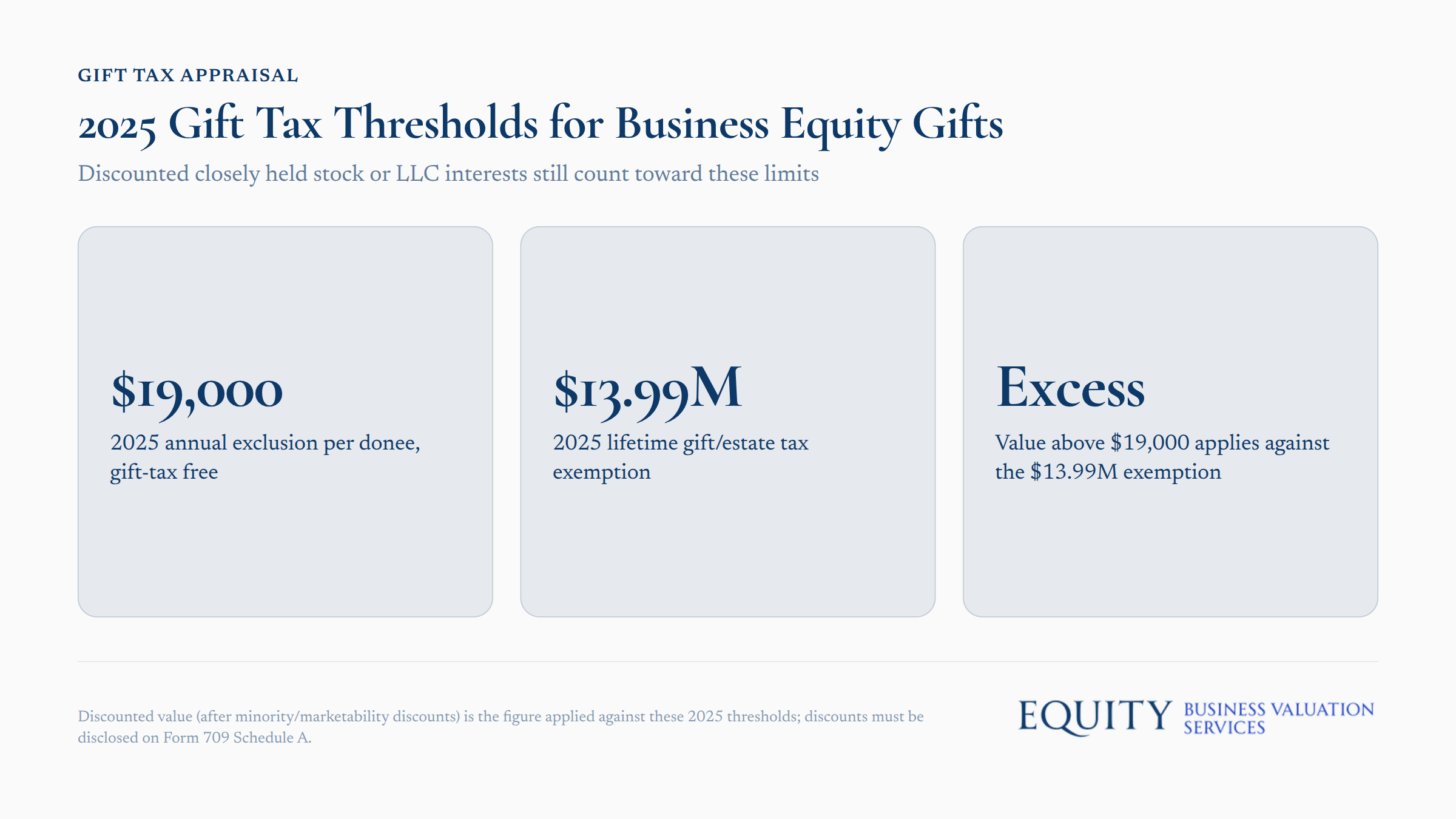
2025 Annual Exclusion and Lifetime Exemption Figures
For 2025, a donor can give up to $19,000 per donee without using any lifetime exemption or filing being required for that gift alone, per the current Form 709 instructions. Gifts of business equity above that amount to any one person in a calendar year generally trigger a filing obligation, even if no tax is ultimately owed.
Beyond the annual exclusion, each donor has a lifetime exemption of $13.99 million for 2025 that shelters larger gifts from gift tax, dollar for dollar, as the exemption is used. A donor gifting a $2 million minority interest in a family business, for instance, would report the full value on Schedule A, apply the $19,000 annual exclusion where applicable, and apply the remainder against the lifetime exemption rather than paying tax out of pocket. Filing the return correctly still matters even when the exemption fully absorbs the gift, because the return is what starts the statute of limitations on the value reported.
Common IRS Red Flags in Business Equity Gift Reporting
The direct answer: the IRS scrutinizes business equity gifts most closely when the appraisal looks thin, the discounts look stacked, the values look inconsistent across filings, or the property description is too vague to verify. Reporting errors on Form 709 come up often enough in practice that tax attorneys have written extensively about avoiding them, including guidance on common Form 709 reporting errors.
Four patterns tend to draw the most attention:
- Thin appraisals: a report that states a conclusion without walking through the financial analysis or discount support behind it.
- Stacked or aggressive discounts: combining a large minority discount with a large marketability discount without separate, defensible support for each.
- Inconsistent valuations across filings: reporting one value on Form 709 and a different value for the same entity on a later estate tax return or a related-party transaction.
- Vague property descriptions: listing "family LLC interest" without the entity name, class of interest, and percentage transferred.
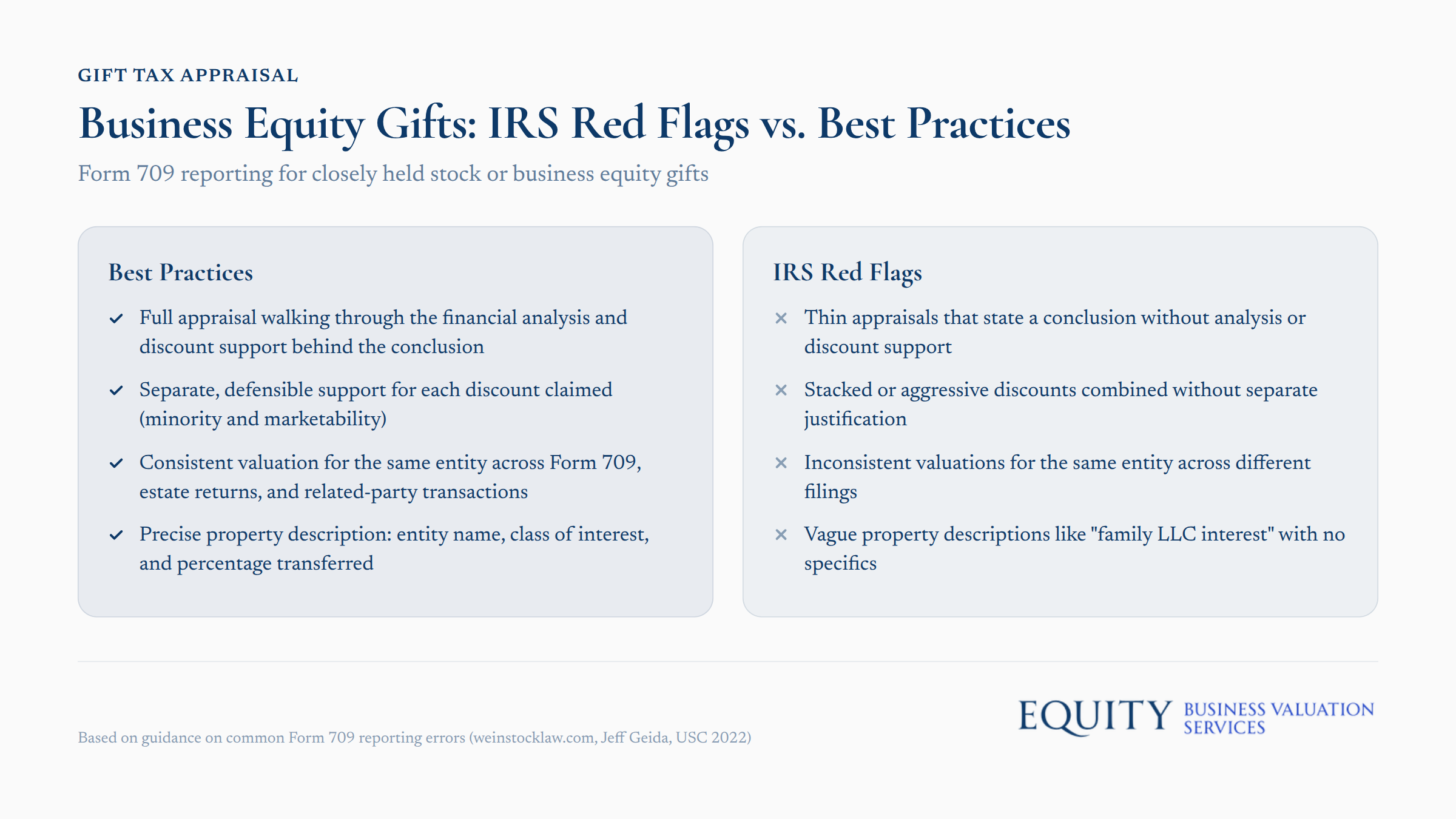
A business equity gift that avoids all four of these patterns, backed by a full appraisal report and a disclosure statement that explains the method and data behind the number, gives the IRS little reason to look twice and gives the donor the statute of limitations protection the disclosure rule is designed to provide.
Getting the Report and the Return Aligned
The appraisal and the tax return are not separate projects. The entity description on Schedule A has to match the interest described in the appraisal, the discount claimed on the return has to match the discount supported in the report, and both have to reflect the value as of the actual gift date. Our team prepares valuations for closely held stock, LLC interests, and partnership units specifically built to support Form 709 reporting and the adequate disclosure standard, and we work directly with donors and their CPAs to make sure the numbers on the return and the numbers in the report tell the same story. If you are planning a gift of business equity, request an appraisal before you file so the valuation is ready when the return is due.
This article is provided for general informational purposes only and does not constitute legal, tax, or financial advice. Readers should consult a qualified attorney or CPA regarding their specific circumstances.