
Blog
What Happens If You Don't File Form 709 When You Should Have
The penalty for not filing a gift tax return is often $0 if your gifts sit inside the lifetime unified credit, which surprises most people. The real cost is that the IRS's three-year window to challenge your gift's value never opens, leaving it exposed for decades.
Missing a required Form 709 feels like it should come with a bill. In most cases, it doesn't. The failure-to-file and failure-to-pay penalties under the tax code are both calculated as a percentage of unpaid gift tax, and for the majority of donors, no gift tax is actually due because the lifetime unified credit absorbs it. That fact leads a lot of people to conclude that skipping Form 709 is harmless. It isn't, and the real exposure shows up years later, often at the worst possible time: during an estate tax examination after the donor has died.
This matters most when the gift wasn't cash but a hard-to-value asset such as an interest in a closely held business, units in a family limited partnership (FLP) or LLC, or restricted stock. Those are exactly the gifts where a qualified gift tax appraisal does real work, because filing on time with adequate disclosure is what starts the clock running on the IRS's ability to challenge the number you reported.
What Happens if You Don't File Form 709 on Time?
If you were required to file Form 709 and didn't, the consequences depend almost entirely on whether gift tax was actually owed for that year. If the gift was covered by the annual exclusion and your remaining lifetime unified credit, there is typically no dollar penalty, but the three-year statute of limitations on that gift never starts, so the IRS can challenge its value indefinitely. If gift tax was owed and unpaid, the standard failure-to-file and failure-to-pay penalties apply, along with interest and possible valuation penalties.
The IRS Form 709 instructions lay out who must file: generally, anyone who gives more than the annual exclusion amount to a single person in a calendar year, anyone electing gift-splitting with a spouse, and anyone making certain gifts to a non-citizen spouse or generation-skipping transfers regardless of amount.
How the Failure-to-File and Failure-to-Pay Penalties Are Calculated
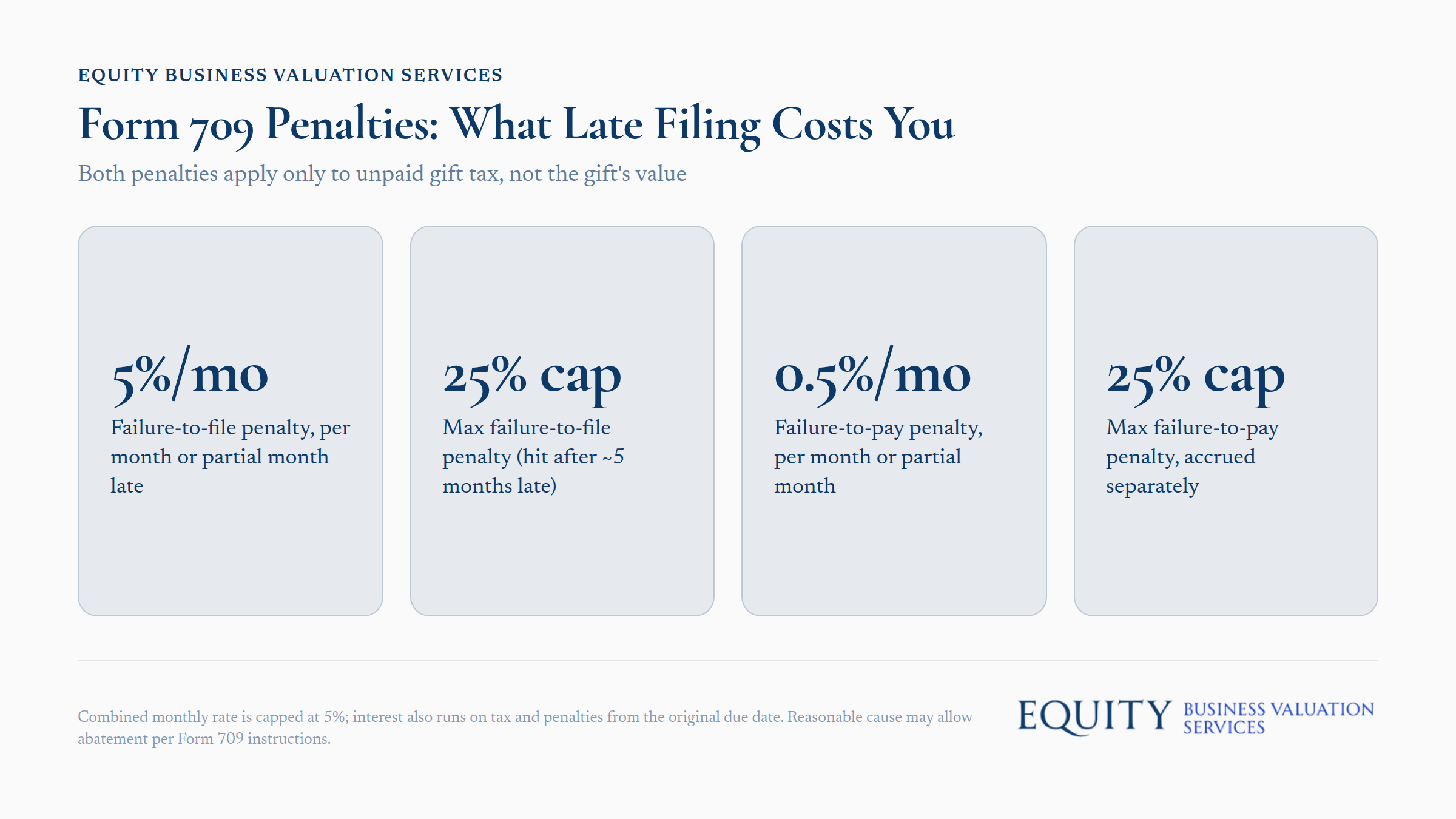
Both penalties attach to Chapter 12 gift tax returns through the same general framework that applies to most federal returns. The math is straightforward once you know it's based on unpaid tax, not on the value of the gift itself.
- Failure-to-file penalty: 5% of the unpaid gift tax for each month or partial month the return is late, capped at 25% of the unpaid tax.
- Failure-to-pay penalty: 0.5% of the unpaid gift tax per month or partial month, also capped at 25%.
- Combined cap: when both penalties run for the same month, the failure-to-file penalty is reduced so the combined rate does not exceed 5% per month.
- Reasonable cause exception: penalties can be abated if you show the failure was due to reasonable cause and not willful neglect, per the Form 709 instructions.
Example: Say a donor owed $100,000 of gift tax and filed three years late with no extension. The failure-to-file penalty hits its 25% ceiling ($25,000) after about five months of lateness, the failure-to-pay penalty accrues separately toward its own 25% cap, and interest runs on both the tax and the penalties from the original due date. That's a real, expensive outcome, but it only happens when tax was actually due.
The Biggest Misconception: Why Many Late Filers Owe $0 in Penalties
Most donors who skip a required Form 709 never see a penalty notice, and that's because the percentages above are computed on tax owed, not on the size of the gift. With the lifetime unified credit running into the millions of dollars per individual, a gift large enough to require a Form 709 rarely generates any current tax liability.
Tax industry analysis of this exact gap is direct about it: the failure-to-file penalty applies only when a tax is actually due and owing, so no penalty is triggered unless a taxpayer's aggregate gifts exceed their lifetime exclusion amount. Academic commentary on the same rule describes the gift tax penalty regime as effectively toothless in practice, precisely because it's tied to unpaid tax rather than unreported value.
Watch out: Owing $0 in penalties is not the same as having no exposure. It just means the exposure shows up somewhere other than a penalty notice, and that somewhere is the statute of limitations.
The Real Risk Isn't the Penalty, It's the Open Statute of Limitations
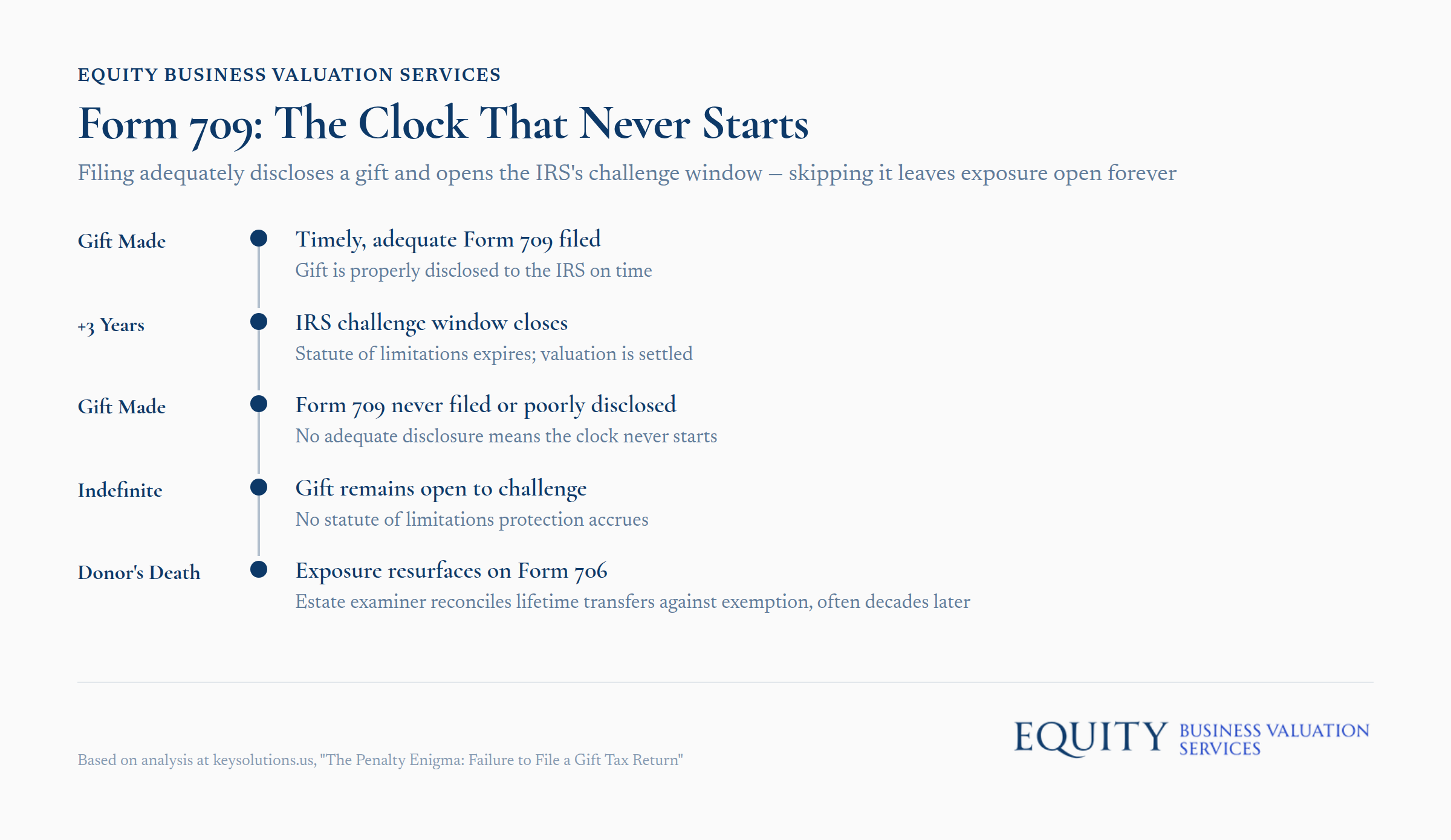
Under the standard three-year assessment rule, the IRS's window to challenge the value you reported on a gift only opens when that gift is adequately disclosed on a timely, properly prepared Form 709. Skip the filing, or disclose the gift poorly, and that window never opens at all. The gift stays permanently subject to IRS challenge, and it typically resurfaces when the donor's estate files Form 706 and an examiner starts reconciling lifetime transfers against the estate's remaining exemption.
A detailed breakdown of this mechanic notes plainly that filing Form 709 is what starts the three-year clock, and that failing to file leaves the transfer open to challenge indefinitely, often surfacing at death during the estate tax examination. By the time that happens, records are older, the original appraiser may be unreachable, and the family is defending a valuation decades after the fact instead of at the time the gift was made.
Why This Matters Most for Business Interests, LLC and FLP Units, and Restricted Stock
Cash gifts and gifts of publicly traded securities rarely create valuation disputes; the numbers are objective and easy to verify. Gifts of closely held business interests, family limited partnership or LLC units, and restricted stock are a different story. Their value depends on judgment calls: which valuation approach applies, what discount for lack of control is appropriate, and what discount for lack of marketability fits the specific interest being transferred.
Those are the gifts most likely to draw an IRS challenge years later if the statute of limitations never closed. A donor who transfers FLP or LLC units without a timely, well-documented Form 709 and a supporting appraisal is leaving that valuation permanently open to reexamination. Our related guide on how valuation discounts work in gift tax appraisals for FLP and LLC interests walks through how those discounts get built into a defensible report.
Pro tip: If you're gifting an interest that doesn't trade on an open market, treat the appraisal and the timely filing as a package. One without the other doesn't start the clock.
What Adequate Disclosure Requires to Start the Clock
Filing Form 709 on time is necessary but not sufficient. To trigger the three-year statute, the return has to adequately disclose the transfer, meaning it needs enough detail that the IRS could reasonably identify the transferred property, the valuation method used, and the relationship between the parties. A bare-bones return that lists a dollar figure without supporting documentation may not meet that bar.
This is where a qualified, independent appraisal earns its keep. An appraisal prepared in accordance with USPAP (the Uniform Standards of Professional Appraisal Practice, published by The Appraisal Foundation) gives the return the documentation an examiner needs to evaluate the reported value without asking for more, which is exactly what adequate disclosure requires.
If You Missed a Filing, What Should You Do Now?
A missed Form 709 from a prior year isn't necessarily fatal, and filing late is almost always better than not filing at all, even years afterward. If no gift tax was due, a late-filed return with adequate disclosure can still start the statute of limitations running from the date it's filed, closing off that indefinite exposure. Practical guidance on late gift tax filings consistently recommends filing as soon as the omission is discovered rather than waiting, since the earlier the disclosure, the earlier the clock starts.
Before filing a late return for a hard-to-value gift, get a current, independent appraisal of the asset as of the original gift date. That valuation, combined with full disclosure on the return, is what converts an open-ended risk into a closed chapter.
Key takeaway: The dollar penalty for not filing Form 709 is usually smaller than people fear. The real cost is an IRS challenge that can surface decades later with no time limit, and the only way to close that door is a timely, well-documented filing supported by a defensible appraisal.
This article is provided for general informational purposes only and does not constitute legal, tax, or financial advice. Readers should consult a qualified attorney or CPA regarding their specific circumstances.