
Blog
How to Value a Minority Interest in a Family Business for Gift Tax Purposes
A minority interest gifted out of a family business is worth less than its pro-rata share, and the IRS agrees, within limits. This guide explains how the minority interest discount for gift tax works, what supports it, and how to report it correctly on Form 709.
When a parent gifts a 10% or 15% stake in the family business to a child, the IRS does not tax the gift on a simple pro-rata slice of the company's total value. Because that stake carries no vote, no control over distributions, and no ability to force a sale, it is worth less to a hypothetical buyer than its arithmetic share would suggest. That gap is the minority interest discount, and getting it right on a gift tax return is one of the more scrutinized calculations a family business ever files with the IRS.
This guide walks through the legal standard behind the discount, how large a discount the IRS and courts actually tolerate, where the limits sit under IRC 2704, and how to report the gift on Form 709 without inviting an audit. If you are structuring the transfer through a family limited partnership or LLC, our guide to valuation discounts for FLP and LLC interests covers that mechanism in more depth. Our gift tax appraisal team prepares these valuations for direct fractional gifts of operating businesses and family-owned real estate alike.
Why a Family Business Gift Isn't Valued at Its Simple Percentage
A 15% interest in a $10 million company is not automatically worth $1.5 million for gift tax purposes. Fair market value, the standard that governs every gift tax valuation, asks what a hypothetical willing buyer would actually pay for that specific block of ownership, not what the company is worth as a whole divided by a percentage.
The governing regulation is Treas. Reg. §25.2512-1, which defines value as the price at which property would change hands between a willing buyer and willing seller, neither under compulsion, both reasonably informed. For stock and closely held equity specifically, Treas. Reg. §25.2512-2(f) directs the appraiser to consider the degree of control the block represents as one of the factors in the valuation. A block with no vote and no control is not the same asset, economically, as a block that carries the company. That distinction is the entire legal basis for the minority interest discount.
This same fair market value standard traces back to the IRS's own bedrock revenue ruling on business valuation, which established that earnings, book value, dividend-paying capacity, and comparable transactions all factor into the value of a closely held interest. That ruling remains the foundation appraisers cite when explaining why a non-controlling interest is analyzed differently from a controlling one. To see how the IRS applies fair market value to gifted property more broadly, see how gifts are valued for tax purposes.
Rev. Rul. 93-12: How the IRS Dropped Family Attribution
The IRS did not always allow minority discounts on gifts between family members. In an earlier ruling, the IRS reasoned that when a family as a group holds control of a corporation, each family member's shares should be valued as if the family owned it as a single controlling block, denying any minority discount for gifts between relatives, as laid out in Rev. Rul. 81-253.
That position changed. In Rev. Rul. 93-12, the IRS abandoned family attribution for gift tax valuation. Each individual's equity interest is now valued on its own, based on what an outside, unrelated buyer would pay for that specific block, regardless of how much control the family holds in aggregate. A parent who gifts a 15% interest to a child gets a minority discount on that 15% block even though the parent and child, taken together, may still control the company after the gift.
This reversal is why fractional gifts of family businesses remain one of the more effective estate planning tools available, and it is also why the IRS scrutinizes them closely: the discount only holds up when it reflects a genuine, arm's-length lack of control, not a paper restructuring designed purely to shrink a gift tax bill, a point the IRS and Tax Court have made in contested minority-interest cases.
Watch out: A discount created purely by splitting an interest into fractional pieces right before a transfer, with no independent business purpose, invites challenge. The discount needs to reflect how the entity actually operates, who actually controls it, and what a real buyer would actually pay.
How Large Is a Minority Interest Discount in Practice?
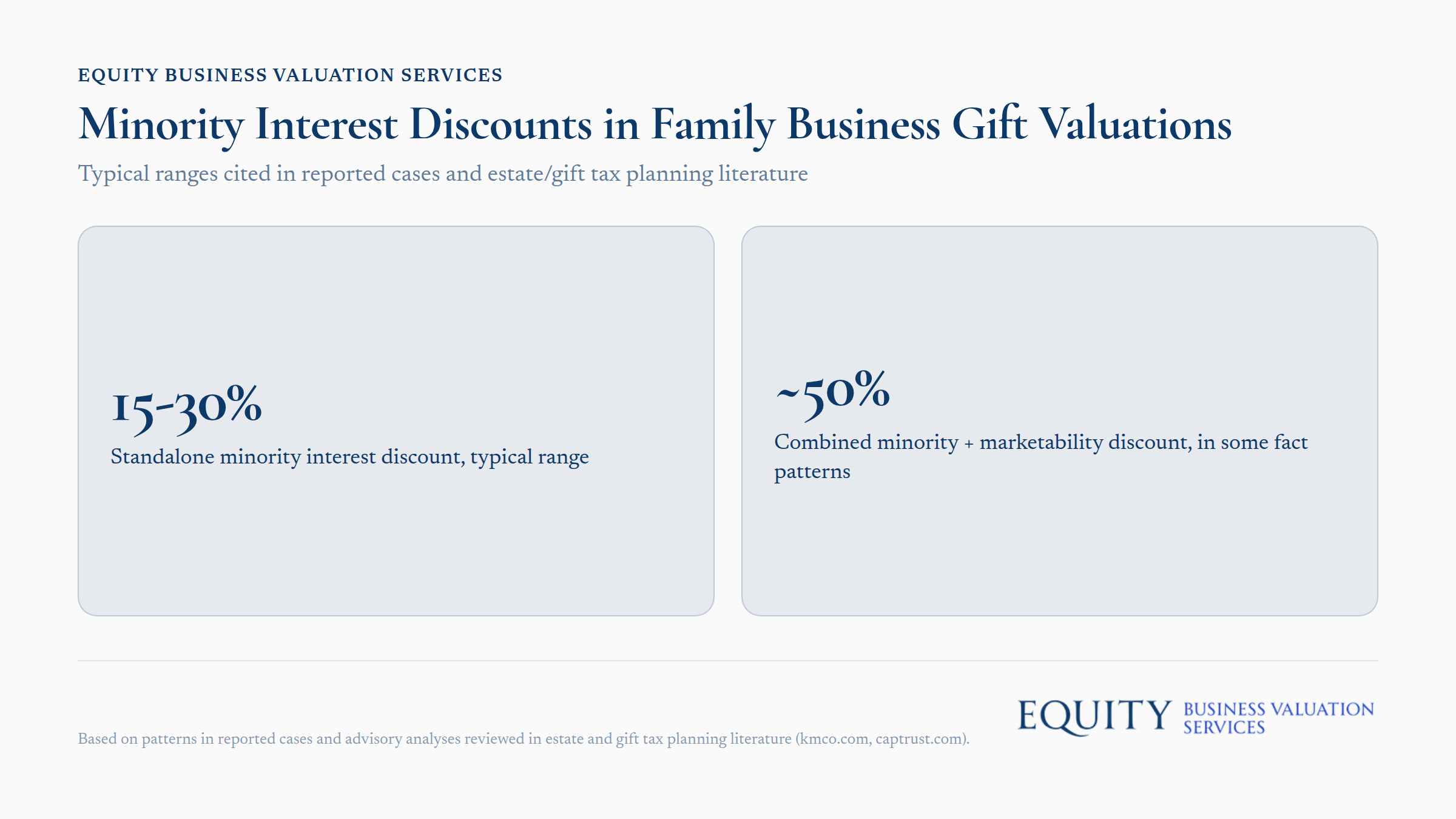
Minority interest discounts for gifted family business interests typically fall in the range of about 15% to 30% of the pro-rata value, based on patterns seen across reported cases and professional valuation practice. There is no fixed statutory percentage; the number has to come from data specific to the interest being valued, not a round figure picked off a chart.
Appraisers support the discount with evidence such as:
- Comparable minority transactions: Sales or restricted-stock studies showing what buyers actually paid for non-controlling stakes in similar entities.
- The entity's actual governance: Whether the minority holder has any board seat, veto right, or say in distributions, drawn from the operating agreement or bylaws.
- Distribution history: Whether the entity regularly distributes cash or reinvests earnings, since a minority holder with no distribution rights has less practical value in hand.
- Industry and size-specific studies: Published data on minority discounts observed in transactions of comparable size and sector.
Combined minority and marketability discounts (discussed below) can run higher, sometimes approaching 50% in specific fact patterns, according to advisory analyses of family entity transfers reviewed in estate and gift tax planning literature. The size of any discount always has to trace back to real, documented evidence about the specific interest, the specific entity, and the specific market for interests like it, as outlined in broader discussions of valuation discounts and estate tax savings.
IRC 2704: Where Family Discount Planning Hits a Wall
IRC §2704 limits how far a family can push valuation discounts by disregarding certain restrictions that only exist because the entity is family-controlled. If an operating agreement includes a restriction on a family member's ability to liquidate or withdraw that would not exist in an arm's-length deal with an unrelated party, that restriction can be ignored when valuing the gifted interest, even if it would otherwise support a larger discount.
The IRS has tried to go further than the statute at times. In 2016, the Treasury proposed regulations under §2704 that would have eliminated or sharply curtailed discounts for family entities holding passive investments, treating many minority and marketability discounts as artificial. Those proposed regulations were withdrawn in 2017 and never took effect, meaning minority interest discounts remain available under current law, but the episode is a reminder that this is an area regulators watch closely and could revisit, as detailed in analyses of the proposed and withdrawn 2016 regulations.
Pro tip: A discount that survives IRS scrutiny is one built on the entity's real operating terms and real market comparables, not restrictions drafted solely to inflate the discount. Document the business purpose for how the interest is structured, separate from the tax outcome.
Worked Example: Gifting a 15% Interest in a Family Business
Assume a family operating company is worth $10 million on a controlling, marketable basis. A parent gifts a 15% non-voting interest to an adult child.
| Step | Calculation | Value |
|---|---|---|
| Pro-rata value | 15% x $10,000,000 | $1,500,000 |
| After minority (lack of control) discount | $1,500,000 x (1 - 20%) | $1,200,000 |
| After marketability discount | $1,200,000 x (1 - 15%) | $1,020,000 |
| Reported gift value on Form 709 | $1,020,000 |
Example: Instead of reporting a $1.5 million gift, the appraisal supports a reported value of $1,020,000, a reduction of $480,000, or 32% of the pro-rata figure. The 20% minority discount and 15% marketability discount in this example are illustrative; a real appraisal would derive each percentage from comparable minority transactions, the entity's governance documents, and its distribution history, not from a preset target.
That $480,000 difference directly reduces how much of the donor's lifetime exemption is consumed by the gift, or how much gift tax is owed if the exemption is already used. It is also exactly the kind of number the IRS will ask an appraiser to defend if the return is examined.
Form 709, Qualified Appraisals, and Adequate Disclosure
A gift of a minority interest in a family business must be reported on Form 709 (United States Gift and Generation-Skipping Transfer Tax Return). When the reported value reflects a lack-of-control or lack-of-marketability discount, adequate disclosure rules under Treas. Reg. §301.6501(c)-1(f)(2) come into play: the return needs a description of the transferred interest, the valuation method used, and enough detail for the IRS to understand how the discounted value was reached.
Adequate disclosure matters because it starts the three-year statute of limitations on the IRS challenging the gift's value. Without it, the IRS can revisit the valuation indefinitely. A qualified appraisal prepared by a credentialed appraiser, attached to the return, is the standard way families satisfy this requirement, particularly given how the lifetime gift and estate tax exemption is scheduled to change and why locking in a discounted value now can matter for larger estates, as noted in reviews of current exemption levels and expanded family business planning. See IRS.gov for the current Form 709 instructions.
Business valuations prepared for gift tax purposes are quoted as a fixed fee after we scope the engagement, never billed hourly. An IRS-qualified business valuation report for this kind of assignment is typically quoted starting around $5,500, scaling with the number of interests involved, the completeness of the entity's financial records, and the depth of comparable-transaction research required, not with the value of the business itself.
Minority Discount vs. Discount for Lack of Marketability
The minority interest discount and the discount for lack of marketability are related but separate concepts, and a gift tax appraisal often applies both. The minority discount addresses the interest's lack of control: no vote, no say over distributions, no ability to force a sale. The marketability discount addresses a different problem: even a controlling owner in a closely held business can't sell quickly or easily, because there's no public market for the shares.
Both discounts get applied to the same pro-rata value, typically in sequence, as shown in the worked example above. Our separate guide on the discount for lack of marketability in gift and estate tax valuations covers that discount's own legal basis and typical range in more detail.
Getting a Defensible Valuation Before You File
A minority interest discount can meaningfully reduce the gift tax exposure of transferring a family business to the next generation, but only when the number behind it is built on real comparable data, documented governance facts, and a fair market value analysis that would hold up under IRS review. Rounding to a familiar percentage, or copying a discount from someone else's transaction, is the fastest way to draw an audit.
If you're planning to gift a fractional interest in a family business or family-owned real estate, our appraisers prepare USPAP-compliant, IRS-qualified valuations built for Form 709 reporting. Request an appraisal to get a fixed-fee quote scoped to your entity and the interest being gifted.
This article is provided for general informational purposes only and does not constitute legal, tax, or financial advice. Readers should consult a qualified attorney or CPA regarding their specific circumstances.