
Blog
What Triggers an IRS Audit of a Gift Tax Appraisal: Key Red Flags
Aggressive discounts, weak appraiser credentials, and undervalued closely held interests are the fastest ways to draw IRS scrutiny to a Form 709 valuation. This guide breaks down the specific triggers and the disclosure rule that decides whether the audit window ever closes.
Gift tax returns don't get pulled for examination at random. When the IRS challenges the appraised value behind a Form 709, the file almost always shares one or more identifiable weaknesses: discounts nobody can defend, an appraiser whose qualifications don't hold up, a closely held interest valued well below what the underlying financials support, or a report that reads like a conclusion with no work shown. This guide walks through the specific conditions that draw IRS scrutiny to a gift tax appraisal, the disclosure rule that decides whether the statute of limitations ever starts running, and what separates a defensible report from a vulnerable one. Attorneys, CPAs, and fiduciaries advising on FLP interests, LLC transfers, or closely held stock gifts can use it to pressure-test a valuation before it ever reaches a return. Our gift tax appraisal team builds every report around these same standards.
What Actually Puts a Gift Tax Appraisal in the IRS's Crosshairs
The IRS does not publish a scoring formula for which gift tax appraisals get selected for exam, but its own manuals and penalty rules point to the same handful of conditions every time. Estate and gift examiners are directed to pull every previously filed Form 709 connected to an estate under review, and the Internal Revenue Manual's estate and gift examination guidance calls for valuation assistance whenever a return's size or complexity signals risk. In practice, that means large lifetime-exemption gifts of hard-to-value assets get more attention than routine annual-exclusion transfers.
Four characteristics show up repeatedly in appraisals that end up challenged: unsupported discounts, thin or missing appraiser qualifications, entity valuations that sit well below what the numbers justify, and reports that skip the computations entirely. Each is worth understanding on its own.
Aggressive Minority and Marketability Discounts Without Support
Discounts for lack of control and lack of marketability are legitimate, well-established tools when a donor transfers a minority interest in a family limited partnership, an LLC, or closely held stock. The problem is not that discounts exist. The problem is when an appraisal applies a large discount, sometimes 30% or 40% off a pro rata net asset value, without any market data, comparable transaction analysis, or quantitative model behind the number.
An IRS examiner reviewing a return with a steep, unexplained discount has an easy target: ask the appraiser to show the work, and if there isn't any, the valuation collapses under its own weight. Our guide to how valuation discounts work in gift tax appraisals covers the analysis a defensible discount actually requires, including restricted stock studies, partnership profile data, and entity-specific adjustments.
Watch out: A discount that happens to land at a round number, exactly 35% or exactly 40%, with no bridge from the underlying data to that figure, reads to an examiner as a target rather than a conclusion.
Missing or Weak Qualified Appraiser Credentials
Who signs the report matters almost as much as what it says. An appraisal prepared by someone without recognized valuation credentials, without independence from the donor or the entity being valued, or without documented experience in the specific asset class, gives the IRS an immediate reason to discount the report's weight. For business and closely held entity interests, credentials such as ASA or NACVA accreditation, combined with independence from the transaction, are what examiners and courts expect to see.
A related problem shows up when the appraiser is a family accountant, a business partner, or someone else with a financial stake in the outcome. Even a technically sound valuation loses credibility fast when the preparer isn't independent. That's a separate failure from methodology, and it's one the IRS can raise without ever disputing a single number.
Undervalued Closely Held Stock, LLC, and FLP Interests
When a reported gift value sits far enough below what the IRS later determines to be correct, the return doesn't just risk a value adjustment. It risks a penalty. Under IRC Section 6662, a substantial estate or gift tax valuation understatement exists when the value claimed on the return is 65% or less of the correct value, triggering a 20% accuracy-related penalty on the resulting underpayment. If the claimed value is 40% or less of the correct value, the understatement is treated as gross, and the penalty rate doubles to 40%. The Treasury regulations implementing these valuation misstatement rules apply the same framework to estate and gift valuations as to income tax valuation disputes.
Example: A donor gifts an LLC interest reported at $400,000. If the IRS later establishes the correct value at $700,000, the reported figure is roughly 57% of correct value, well inside the substantial understatement threshold, and the resulting underpayment is subject to a 20% penalty on top of the additional gift tax owed.
These thresholds are exactly why aggressive, unsupported discounts on FLP and LLC interests draw disproportionate attention. The larger the gap between reported and defensible value, the larger the exposure once an examiner reworks the numbers.
Round-Number Valuations and Missing Computations
A report that shows only a final number, with no visible bridge from financial statements to that number, is a red flag independent of whether the value itself is defensible. IRS guidelines for reviewing taxpayer-prepared appraisals call for examiners to test the data behind the conclusion: the comparables selected, the discount rate assumptions, and whether recognized approaches (income, market, or asset-based) were applied consistently. The IRS's real property valuation guidelines, while written for real estate, describe the same risk-based review process examiners apply to any taxpayer appraisal: the thinner the documentation, the more likely a full independent review follows.
A gift tax appraisal report should show its computations, not just its conclusions. That standard traces back to long-standing IRS guidance on the format and content of gift tax appraisal reports, which calls for a description of the property, the valuation date, the method applied, the data relied upon, and the appraiser's qualifications and signed statement of independence. A report missing any of these elements is easier to challenge, regardless of whether the final number happens to be correct.
Adequate Disclosure: The Rule That Decides Whether the Audit Window Ever Closes
The single most consequential trigger in gift tax valuation isn't a discount or a credential. It's disclosure. Under normal circumstances, the IRS has three years from the filing of a Form 709 to assess additional gift tax. But that three-year clock only starts if the gift is adequately disclosed. If it isn't, the IRS can assess tax on that gift at any time, with no statute of limitations at all.
The Treasury regulations governing adequate disclosure spell out what a return needs to include for the clock to start: a clear description of the transferred property, the relationship between donor and donee, the valuation method and basis used, the financial data relied upon (comparable sales, income statements, balance sheets), and an explanation of any discounts claimed and how they were calculated. Our guide to how Form 709 establishes gift tax basis and starts the statute of limitations walks through this mechanic in more detail.
Key takeaway: Adequate disclosure isn't a formality. A gift that is properly disclosed and unchallenged for three years becomes locked in for both gift and later estate tax purposes. A gift that is inadequately disclosed remains open to IRS challenge indefinitely, even after the donor's death.
What the Courts Have Said About Disclosure Adequacy
Courts have not treated adequate disclosure as a box-checking exercise. In cases such as Jarre v. Commissioner, courts examined whether a donor's disclosure gave the IRS enough substantive information, description of the property, method of valuation, and supporting data, to identify a potential valuation issue without needing to conduct further investigation on its own. The presence of a return, or even the presence of an appraisal, is not automatically sufficient. What matters is whether the disclosure actually functions the way the regulation intends: putting the IRS on notice of exactly what was valued and how.
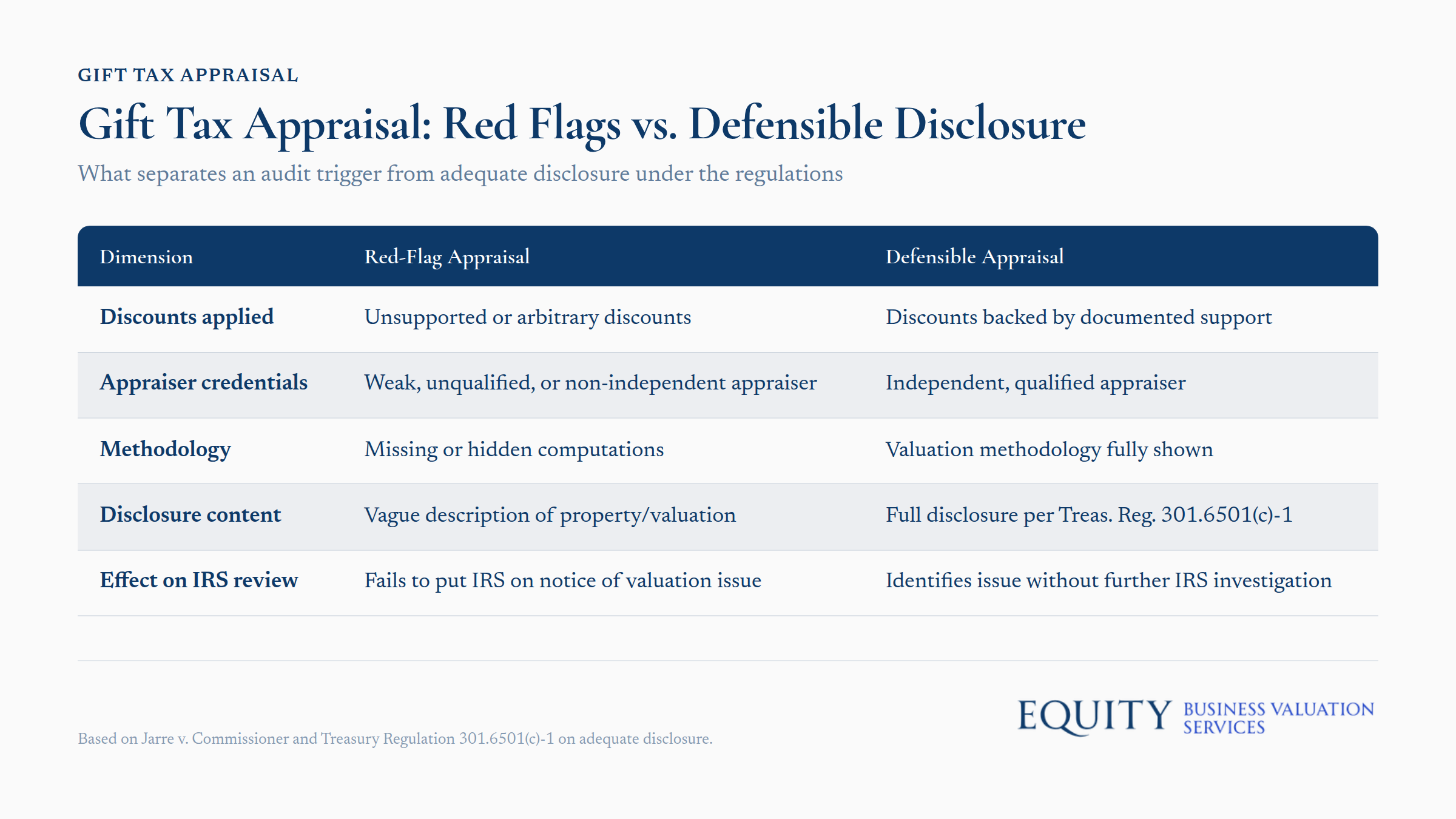
Red-Flag vs. Defensible Gift Tax Appraisal Characteristics
The following comparison summarizes the distinction between an appraisal that invites scrutiny and one built to withstand it.
| Characteristic | Red-Flag Appraisal | Defensible Appraisal |
|---|---|---|
| Discounts applied | Flat percentage discount with no analysis | Discount tied to comparable data and a documented model |
| Appraiser qualifications | No recognized credential, or a relative/business associate of the donor | Independent appraiser holding recognized credentials such as ASA or NACVA |
| Valuation methodology | Conclusion stated with no visible computation | Income, market, or asset approach shown step by step |
| Supporting documentation | Missing financial statements, comparables, or restricted stock data | Full financial data, comparables, and discount support attached |
| Form 709 disclosure | Vague description, method not stated | Property, method, relationship, and data disclosed per Treasury Regulation 301.6501(c)-1 |
| Value relative to underlying data | Falls well below what financials support | Reconciled to and consistent with the underlying financial data |
How a USPAP-Compliant, Independent Appraisal Avoids These Triggers
Every trigger above has the same fix: a defensible, standards-compliant appraisal prepared by a qualified, independent appraiser with documented methodology. Reports prepared in accordance with USPAP require the appraiser to disclose the approach taken, the data relied upon, and any assumptions or limiting conditions, which is exactly the information adequate disclosure regulations require appear on or with the Form 709. There is no gap between what a good appraisal contains and what the IRS needs to see.
For closely held business interests, LLC and FLP transfers, and other complex gifts, engagement fees are quoted as a fixed fee after we scope the assignment, based on the complexity of the entity, the completeness of available records, and whether the report needs to be IRS-qualified. That fixed-fee structure, agreed before work begins, is standard across the industry for valuation engagements of this kind; nothing about an appraisal's fee is tied to the value it ultimately concludes.
Building a Gift Tax File That Doesn't Invite a Second Look
The pattern behind IRS challenges to gift tax appraisals is consistent: unsupported discounts, weak appraiser qualifications, undervalued closely held interests, and disclosure that doesn't meet the regulatory bar. None of these are hidden risks. They're identifiable before a return is ever filed, which means they're preventable. A qualified, independent appraiser working from documented data, applying recognized methodology, and disclosing that work clearly on Form 709 addresses every one of them at once.
If you're preparing a gift tax return involving an FLP interest, an LLC transfer, or a closely held stock gift, request an appraisal built to meet USPAP standards and the IRS's adequate disclosure requirements from the outset.
This article is provided for general informational purposes only and does not constitute legal, tax, or financial advice. Readers should consult a qualified attorney or CPA regarding their specific circumstances.