
Blog
Gift Tax vs Estate Tax Appraisals: How Valuation Dates and Methods Differ
A gift tax appraisal is locked to the date the gift is made, while an estate tax appraisal can shift to an alternate date six months after death. This guide explains why that single difference reshapes valuation strategy, timing, and the appraisal itself.
When a family transfers wealth, the tax consequences often hinge on a single question: what was the property worth on a specific date? For a gift tax appraisal, that date is fixed and cannot be revisited later. For an estate tax appraisal, the executor sometimes has a choice. Understanding this difference matters before a transfer happens, not after, because it changes how our gift tax appraisal team scopes the assignment and how much flexibility a family actually has.
Why the Valuation Date Drives the Appraisal
The valuation date is not a formality. It determines which market conditions, which ownership rights, and which restrictions apply to the property being valued. An appraiser working a June transfer cannot use August sales data or a later change in the company's earnings; the analysis has to reflect facts as they existed on the date that governs the filing.
Both gift tax and estate tax rely on the same basic standard: fair market value, defined as the price a willing buyer would pay a willing seller, with neither under compulsion to act and both having reasonable knowledge of the relevant facts. The valuation method (market, income, or asset-based approach) does not automatically change between a gift and an estate. What changes is the calendar.
The Date-of-Gift Rule for Gift Tax Appraisals
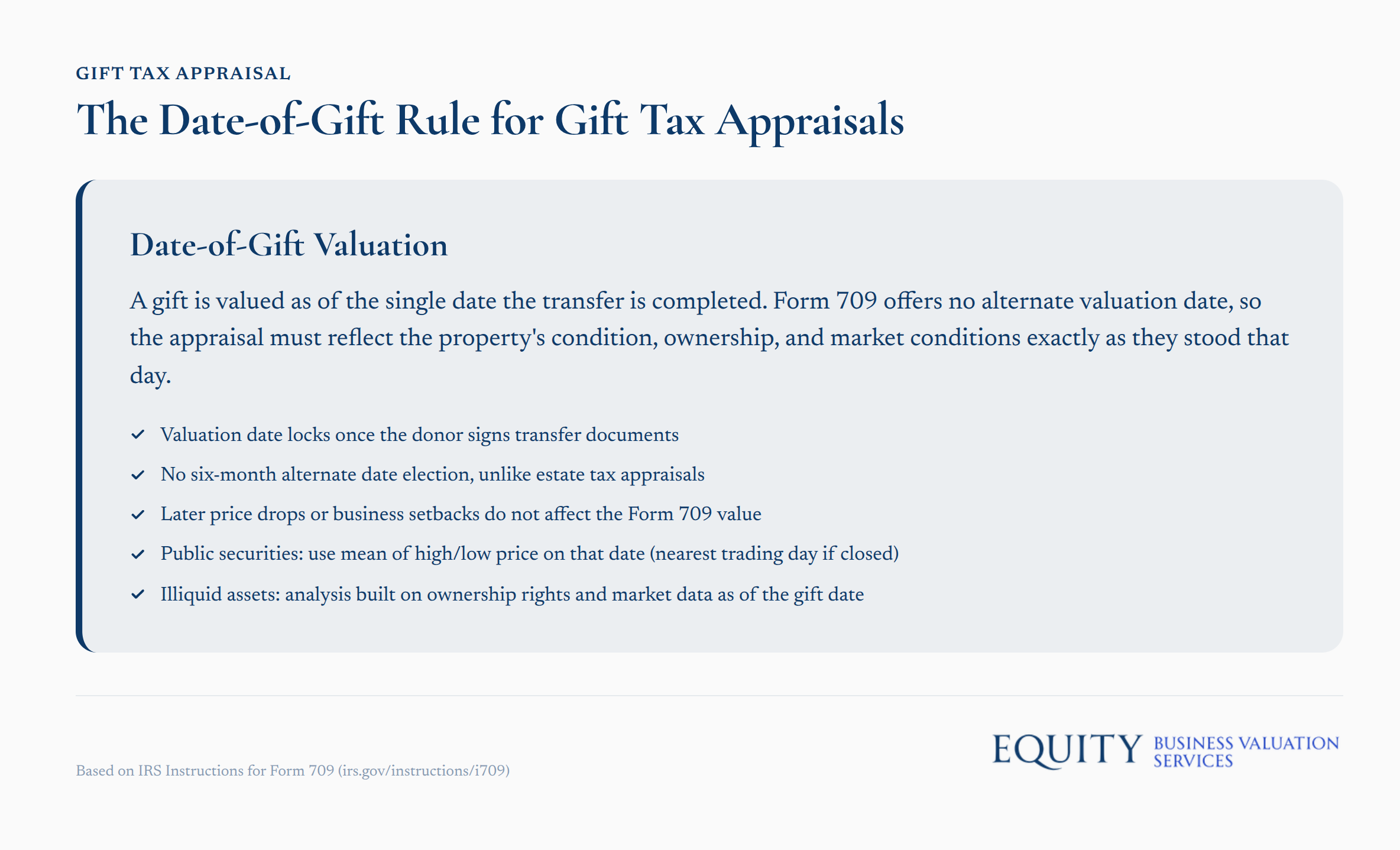
A gift is valued as of the date the gift is completed, and there is no alternate valuation date available for gift tax purposes. The IRS Instructions for Form 709 confirm that the appraisal must reflect the property's condition, ownership percentage, and market conditions as they stood on that single date.
This is a meaningful constraint. Once a donor signs the transfer documents and completes the gift, that valuation date is locked. If the stock drops in value the following week or the family business loses a major contract a month later, none of that matters for the Form 709 filing. The appraisal has to capture the facts as they existed on the date of transfer, not what happened afterward.
For publicly traded securities, the Form 709 instructions specify using the mean of the highest and lowest quoted selling prices on the valuation date, with a nearest-trading-date method if the market was closed that day. For a closely held business interest, real estate, or other illiquid asset, our appraisers build the analysis around the ownership rights, restrictions, and market data that existed precisely on the gift date, since the IRS Instructions for Form 709 treat that date as the only relevant measuring point.
Key takeaway: once a gift is made, the valuation date cannot be shifted. There is no equivalent to the six-month election that estates have available.
The IRC Section 2032 Alternate Valuation Election for Estate Tax
Estate tax works differently. The default rule values estate property at its fair market value on the decedent's date of death, but Section 2032 of the Internal Revenue Code lets an executor elect an alternate valuation date, generally six months after death, according to the regulations governing alternate valuation. That election is not automatic and it is not available just because the executor prefers a lower number.
The election only applies if it decreases both:
- The value of the gross estate, and
- The net federal estate tax liability after credits.
If the alternate date would lower the gross estate value but the net tax liability stays the same or increases (because of how credits and deductions interact), the election is not permitted. The rule exists to give relief to estates that experience a genuine decline in value shortly after death, not to hand executors a second bite at a lower number whenever it is convenient, as explanations of the alternate valuation mechanics make clear.
There is an important wrinkle. Property sold, exchanged, distributed, or otherwise disposed of within the six-month window is not valued at the six-month mark at all. It is valued as of the date of that disposition. Only property the estate still holds at the six-month point gets valued on that later date. This means an executor weighing the election may need two separate appraisals: one at the date of death and one at the alternate date (or at the disposition date for anything sold in between).
One more restriction matters here. IRS guidance has taken the position that the alternate valuation date is meant to capture changes driven by market conditions, not value changes that result from the mere passage of time or from events unrelated to the market itself, a distinction discussed in analysis of the IRS position on alternate valuation. An executor cannot use the election to capture a decline caused by something other than market movement.
What This Means for Gift Timing and Estate Planning
The practical effect of these two rules is that gifting during life and holding an asset until death carry very different appraisal risk profiles. A donor who gifts a depreciating asset takes on the risk that values could recover later, since the gift date is locked in regardless of what happens next. An executor holding the same asset at death has a hedge: if the estate is still administering the property six months later and its value has genuinely dropped due to market conditions, the alternate date may reduce the taxable estate.
That asymmetry should factor into planning conversations well before a transfer happens. Families weighing whether to gift a business interest now or let it pass through the estate later are effectively choosing between a fixed valuation date and one that carries built-in flexibility. Advisors often ask how long a completed appraisal report remains usable for a pending gift, and the answer connects directly to this same locked-date principle; see our answer on how long an appraisal holds up for gift tax purposes for more detail.
For a business interest, real estate holding, or concentrated stock position, this timing question is worth resolving with a qualified appraiser before the transfer, not after. Once a gift is completed, the appraisal date cannot be renegotiated, and the fee for a gift tax appraisal reflects that certainty: it is quoted as a fixed fee once the asset and intended use are scoped, never billed hourly.
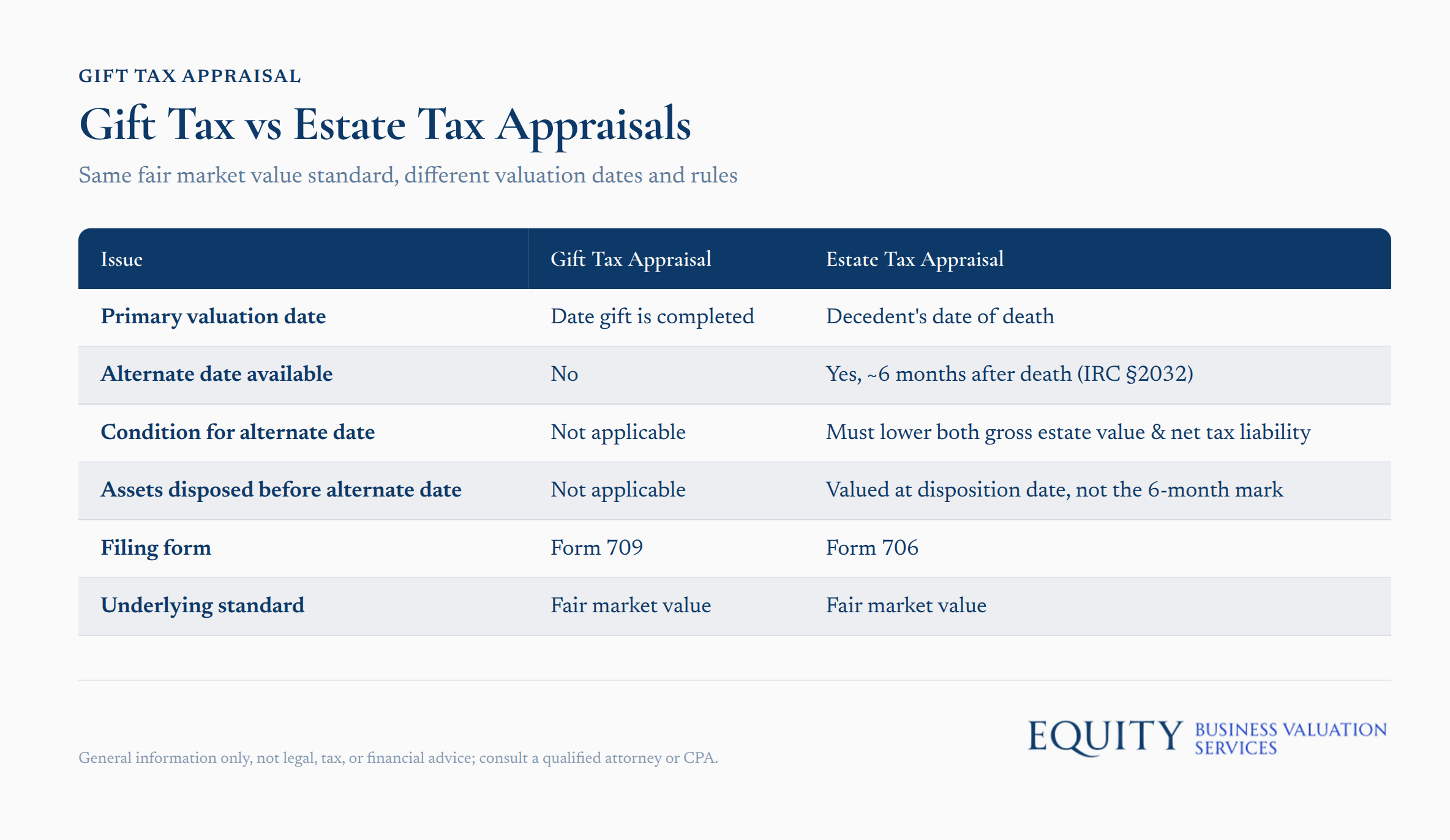
Gift Tax Appraisal vs Estate Tax Appraisal at a Glance
The table below summarizes the core mechanical differences between the two appraisal types.
| Issue | Gift Tax Appraisal | Estate Tax Appraisal |
|---|---|---|
| Primary valuation date | Date the gift is completed | Decedent's date of death |
| Alternate date available | No | Yes, generally 6 months after death (IRC Section 2032) |
| Condition for alternate date | Not applicable | Must lower both gross estate value and net estate tax liability |
| Assets disposed of before alternate date | Not applicable | Valued as of the disposition date, not the 6-month mark |
| Filing form | Form 709 | Form 706 |
| Underlying standard | Fair market value | Fair market value |
At bottom, both appraisal types answer the same question: what would a willing buyer pay a willing seller for this property, with neither side under pressure and both informed of the relevant facts? The difference is which date that question gets asked on, and whether the estate gets a second chance to ask it again six months later. Our appraisers scope every engagement around the transfer type and the applicable date from the outset, so the report matches the return it needs to support, whether that is a completed Form 709 gift or a Form 706 estate filing weighing the Section 2032 election.
This article is provided for general informational purposes only and does not constitute legal, tax, or financial advice. Readers should consult a qualified attorney or CPA regarding their specific circumstances.