
Blog
Discount for Lack of Marketability in Gift and Estate Tax Valuations
A discount for lack of marketability can shrink a gift or estate tax valuation by 20% to 50%, but only when the appraiser's methodology holds up to IRS scrutiny. This guide explains how DLOM is quantified, what ranges courts have accepted, and where the Tax Court has drawn the line.
A discount for lack of marketability (DLOM) is one of the most consequential, and most contested, adjustments in a gift or estate tax business valuation. Applied to a minority interest in a closely held business, family limited partnership, or LLC, it can reduce the reported taxable value by a third or more compared to the interest's pro rata share of the entity's underlying assets. For attorneys, CPAs, and fiduciaries preparing Form 706 or Form 709 filings, understanding how DLOM is derived, and how it has fared in Tax Court, is essential to defending the number on audit.
This article covers what DLOM measures, how appraisers quantify it using restricted stock and pre-IPO studies, the percentage ranges that show up in practice, and the two Tax Court cases, Estate of Mandelbaum v. Commissioner and Huber v. Commissioner, that continue to shape how the IRS reviews these discounts today.
What Is a Discount for Lack of Marketability?
A DLOM is a percentage reduction applied to an equity interest's value to reflect the fact that it cannot be readily converted to cash. Unlike shares of a public company, which trade daily on an exchange, an interest in a closely held business or family entity typically has no ready buyer, no active market, and often faces transfer restrictions written into the governing documents.
The IRS Discount for Lack of Marketability Job Aid frames the concept plainly:
DLOM is appropriate when the prior steps in a valuation have produced a marketable value, but the actual interest being valued cannot be sold with that same ease.
It is worth noting up front that this Job Aid, prepared for IRS engineers and valuation professionals, states explicitly that it is not official IRS position and cannot be cited as authority for a legal position. It is a training and reference document, not a rule, and appraisers and reviewers alike should treat it that way.
The IRS's foundational framework for valuing closely held stock predates the Job Aid by decades. That framework lays out eight factors examiners still use today, including the company's earnings history, book value, dividend-paying capacity, and the economic outlook for its industry, and it remains the starting point for any appraiser building a defensible valuation before a discount is even applied.
Watch out: DLOM is not a substitute for weak underlying valuation work. If the appraiser's income or market approach already understates the interest's value, layering a large DLOM on top compounds the problem rather than correcting it.
DLOM vs. DLOC: Why the Two Discounts Multiply, Not Add
DLOM and the discount for lack of control (DLOC) are related but distinct adjustments, and appraisers apply them in sequence rather than adding them together. DLOC reflects the reduced value of an interest that cannot compel a sale, force a dividend, or direct company policy. DLOM reflects that even a controlling or non-controlling interest, once valued, still cannot be quickly converted to cash. Industry guidance and the IRS Job Aid both direct appraisers to apply DLOM after any minority interest discount or control premium, not before.
Because the two discounts are multiplicative, a 25% DLOC and a 30% DLOM do not produce a 55% combined discount. They produce a smaller number:
Example: A 10% interest in a family LLC has a pro rata value of $100,000 before discounts. Applying a 25% DLOC brings the value to $75,000. Applying a 30% DLOM to that figure brings it to $52,500, a combined economic discount of 47.5%, not the 55% a simple addition would suggest.
This distinction matters on audit. An examiner who sees discounts added together rather than multiplied will often flag the report on that basis alone, regardless of whether the individual percentages were reasonable. Appraisers preparing reports for gift and estate tax purposes should show the sequencing explicitly, not just the final combined percentage.
How Appraisers Quantify DLOM
There is no statutory table or IRS-endorsed percentage for DLOM. Appraisers instead rely on empirical studies and, increasingly, quantitative models, then adjust the benchmark toward the facts of the specific interest.
Restricted Stock Studies
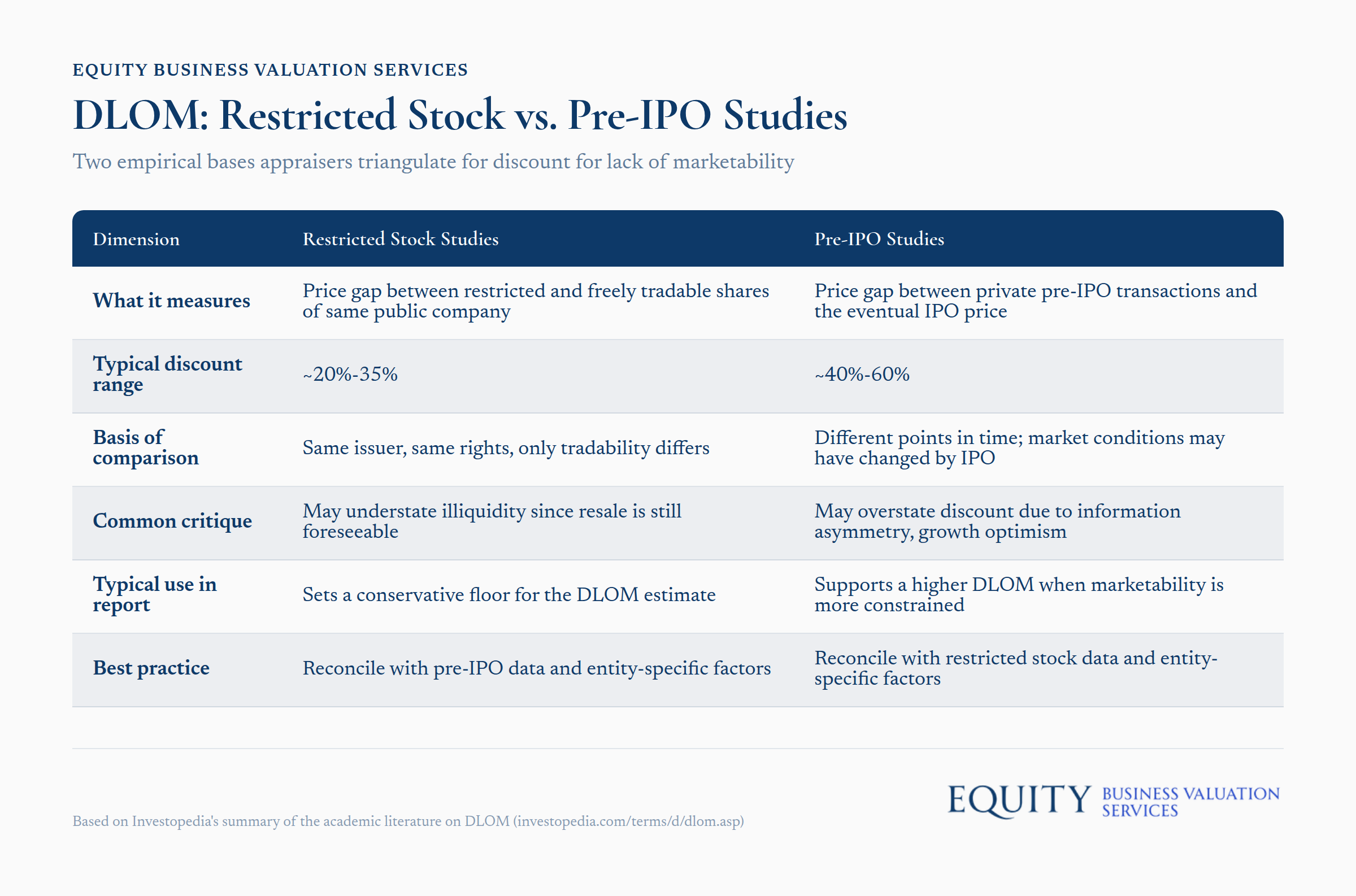
Restricted stock studies compare the price of a public company's freely tradable shares to the price of otherwise identical shares that are restricted from resale for a defined period. Because the two securities differ only in their marketability, the price gap is attributed to the discount for lack of marketability. Synthesized results across these studies commonly show average discounts in the 20% to 35% range, and they remain the most widely used empirical basis for DLOM in gift and estate tax work, largely because the underlying data involves real transactions rather than hypothetical models.
Pre-IPO Studies
Pre-IPO studies compare private transaction prices shortly before a company's initial public offering to the price the same shares command once trading publicly. The percentage gap serves as a proxy for the value of marketability. These studies tend to show a wider range, often cited between 40% and 60%, reflecting the greater uncertainty and risk baked into a pre-IPO transaction. Because pre-IPO discounts run higher than restricted stock discounts, appraisers typically treat them as an upper bound and must explain why a closely held operating business warrants a discount anywhere near that range.
Quantitative and Option Pricing Models
Beyond the two empirical studies, some appraisers apply option pricing models, most often a variation of Black-Scholes, that treat the inability to sell as an embedded put option. The modeled option price, expressed as a percentage of the underlying value, becomes the DLOM estimate. Other practitioners use discounted cash flow-based marketability models that build in an expected holding period, distribution policy, and volatility assumptions specific to the entity. According to Investopedia's summary of the academic literature, the consensus across these combined methods places DLOM somewhere between 30% and 50%, though the spread reflects real methodological differences rather than a single correct answer.
Pro tip: A report that cites only one study type, without reconciling it against the others, is an easier target on audit. The stronger approach triangulates restricted stock data, pre-IPO data, and company-specific factors, then explains why the final number sits where it does.
Typical DLOM Percentage Ranges in Practice
Most DLOMs applied to minority interests in closely held businesses for gift and estate tax purposes cluster in the 20% to 40% range, according to industry valuation sources summarizing decades of restricted stock and pre-IPO data. Some noncontrolling interests, particularly those with significant transfer restrictions or thin distribution histories, see discounts of 30% to 50% relative to a comparable publicly traded counterpart. Sofer Advisors notes that the appropriate figure depends heavily on industry, company size, and the realistic exit options available to the holder.
Discounts above roughly 40% draw closer scrutiny from the IRS, and appraisers who conclude at that level should expect the examiner to look hard at whether the company-specific facts genuinely support it, or whether the number was pulled from the upper end of a study range without sufficient justification. This is not a bright-line rule the IRS has published; it is a pattern that shows up consistently in audit experience and in the cases discussed below.
Rev. Rul. 59-60 and the IRS's Own Valuation Framework
The IRS's foundational guidance for valuing closely held stock, still in force after more than six decades, sets out eight factors examiners weigh: the company's history and nature, the economic outlook for its industry, book value and financial condition, earning capacity, dividend-paying capacity, goodwill and intangible value, prior sales of the stock, and the market price of comparable publicly traded companies. DLOM does not stand apart from this framework; it is layered on top of a valuation conclusion that already reflects these eight factors. An appraiser who skips straight to a discount percentage without first building a defensible base valuation under this framework has left the report exposed at its foundation, not just at the discount stage.
Mandelbaum and Huber: How Tax Court Cases Shaped DLOM Scrutiny
Two Tax Court decisions remain the most frequently cited authority on DLOM in gift and estate tax matters, and both continue to inform how the IRS approaches these discounts today.
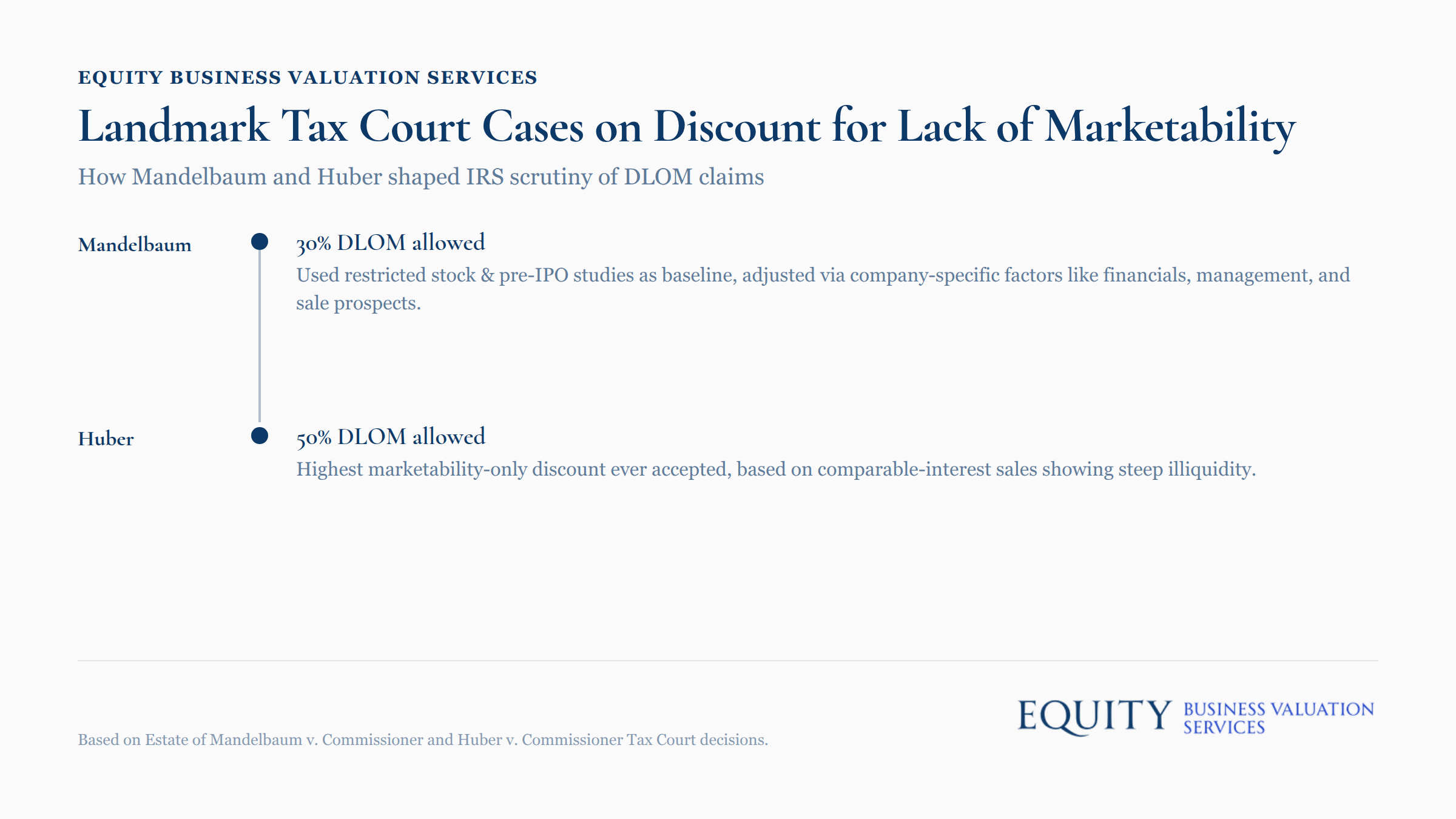
In Estate of Mandelbaum v. Commissioner, the only issue before the court was the appropriate discount for lack of marketability. The court used both restricted stock studies and pre-IPO studies as a starting point, then adjusted from that average based on a list of company-specific factors, including the company's financial statements, dividend policy, the nature of the business and its industry outlook, management strength, restrictions on transferability, and the prospects for a future sale or liquidity event. After weighing those factors, the court concluded that the balance of adjustments ran downward and allowed a 30% DLOM. The Mandelbaum factors remain a standard checklist appraisers use to justify where within a benchmark range their conclusion falls, and IRS examiners routinely check whether a report has addressed them.
In Huber v. Commissioner, the Tax Court allowed a 50% discount for lack of marketability, the highest discount the court has permitted based on marketability alone rather than combined with other factors. The court permitted that unusually high figure based on its finding that sales of comparable interests supported a steep illiquidity discount under the specific facts of that case. Huber illustrates that while 50% sits at the outer edge of what the Tax Court has accepted, it is not an automatic ceiling; it simply requires an unusually strong factual record to support it.
Both cases also serve as a caution in the other direction. Where family entities have been formed primarily for tax purposes, with weak formalities and little genuine restriction on liquidity, courts have pushed back hard on claimed discounts. In one FLP case summarized by MJ CPA, the Tax Court rejected the taxpayer's valuation discounts entirely because the partnership was viewed as primarily tax-motivated rather than reflecting a genuine marketability constraint. The lesson for practitioners preparing a gift tax appraisal is the same one that runs through Mandelbaum and Huber alike: the discount has to match the real economic facts of the entity, not just a percentage pulled from a study.
Key takeaway: Courts have accepted DLOMs anywhere from roughly 8% to 50%, but every case that survived scrutiny did so because the appraiser connected the discount to specific, documented facts about the entity, not because a study alone supported the number.
When Does a DLOM Draw Closer IRS Scrutiny?
A DLOM is more likely to draw IRS scrutiny when it exceeds roughly 40%, relies on a single study type without reconciliation, or is applied to an entity holding mostly marketable securities with minimal genuine transfer restrictions. According to the IRS DLOM Job Aid, examiners are trained to check whether the appraiser's prior valuation steps already produced a marketable or non-marketable figure, since applying DLOM to an already non-marketable value double counts the same economic reality.
Examiners are also instructed to look for entity-specific analysis rather than a discount lifted straight from a published average. A report that walks through the Mandelbaum factors, ties the conclusion to restricted stock and pre-IPO benchmarks, and explains the sequencing against any DLOC will generally hold up far better than one that states a final percentage without that supporting narrative. Fiduciaries preparing a Form 709 filing should expect their appraiser to document this reasoning in full, since it is the documentation, not the discount itself, that the IRS is really evaluating.
Getting the Discount Right Before You File
DLOM sits at the intersection of empirical data and professional judgment, and that combination is exactly why it draws attention on audit. A defensible report ties the discount to restricted stock and pre-IPO benchmarks, walks through the Mandelbaum factors, sequences DLOM correctly against any DLOC, and explains why the final number reflects this entity's facts rather than an industry average. Our team prepares business valuations for gift and estate tax purposes in accordance with USPAP, with appraisers who hold credentials including the ASA and the NACVA and who document valuation discounts with the level of detail an IRS examiner or Tax Court would expect to see. If you are preparing a Form 706 or Form 709 filing that involves a closely held business, family LLC, or limited partnership, request an appraisal before you file, not after the audit notice arrives.
This article is provided for general informational purposes only and does not constitute legal, tax, or financial advice. Readers should consult a qualified attorney or CPA regarding their specific circumstances.